I’ve been using Twain GPT to help draft parts of my school essays, but now I’m worried my work might get flagged by plagiarism or AI-detection tools. I’m not copy-pasting entire outputs, but I do rely on it for structure and wording. Has anyone used Twain GPT for academic or professional writing without getting into trouble, and what precautions should I take to avoid plagiarism or detection issues?
Twain GPT Review: The “Humanizer” That Kind Of… Isn’t
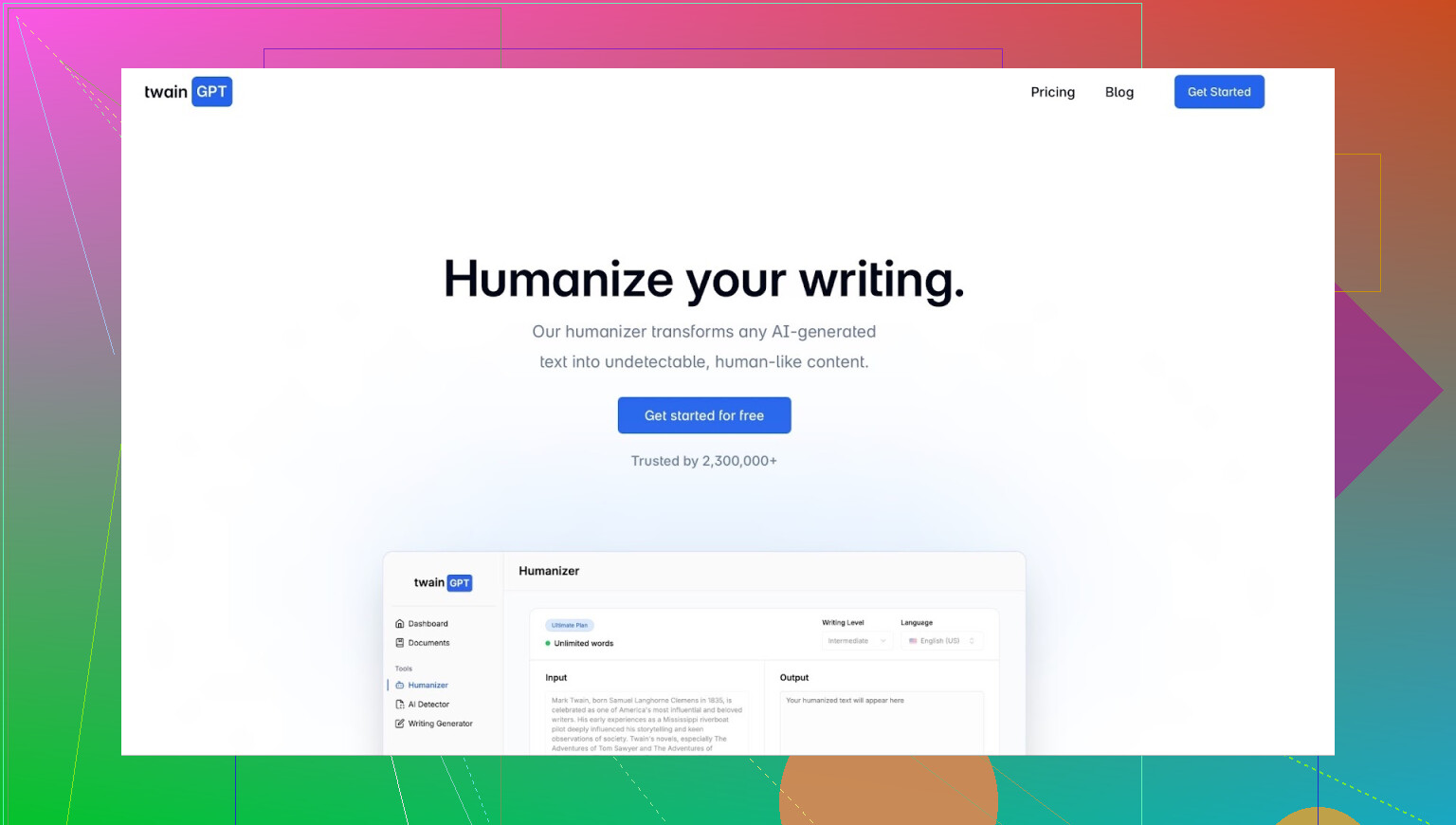
So I spent some time messing around with Twain GPT because their ads kept stalking me all over Google and social media. They pitch themselves as this next‑level “AI humanizer” that can slip past the usual AI detectors like it’s nothing.
On paper, it sounds slick. In practice, it felt like paying for a locked demo while better stuff exists for free.
What Twain GPT Claims To Be
Twain GPT basically screams:
“Premium AI humanizer! Undetectable text! Beats the detectors! Ultimate rewriting tool!”
In reality, here is what I actually ran into:
- It heavily throttles how much you can paste in at once.
- Most useful options feel like they live behind a paywall.
- The final output still lights up AI detectors.
Meanwhile, tools like Clever AI Humanizer do the same job but without trying to choke your wallet or your word count.
Pricing: The Part That Made Me Close The Tab Twice
Twain GPT is not cheap. Not just “meh” pricey, but “why are we doing this when there are free sites?” pricey.
- You get funneled toward a subscription very quickly, even when you’re just trying to test it.
- There are tight word limits that make it hard to use for essays, reports, or anything longer than a paragraph or two.
- The cancellation terms are not obvious at first glance, which is never a good sign.
Compare that with Clever AI Humanizer, which is:
- 100% free
- Offers up to 200,000 words per month
- Allows runs of up to 7,000 words at a time
So on one side: pay a monthly fee, fight word limits, and watch your text still get flagged.
On the other side: don’t pay, get more words, and actually clear detectors.
Kind of kills the “premium” argument.
I Actually Tested It On Detectors
I didn’t want to just trust their marketing or anyone else’s screenshots, so I did a simple test:
- Wrote a standard essay with ChatGPT.
- Verified that the original text scored as 100% AI on multiple detectors.
- Ran that same text through:
- Twain GPT
- Clever AI Humanizer
- Then checked both outputs with a few popular AI detection tools.
Here’s how it shook out:
| Detector | Twain GPT Result | Clever AI Humanizer Result |
|---|---|---|
| GPTZero |  Fail (100% AI) Fail (100% AI) |
 Pass (Human) Pass (Human) |
| ZeroGPT | Fail (100% AI) |
Pass (Human) |
| Turnitin | Fail (89% AI) |
Pass (Human) |
| Copyleaks | Fail |
Pass (Human) |
| Overall | DETECTED | UNDETECTED |
Twain GPT basically rewrote the essay, but the detectors still saw right through it. It looked different, but it felt algorithmic enough that tools picked it up instantly.
Clever AI Humanizer’s output, on the other hand, slid through all of them as human.
So Where Does That Leave Twain GPT?
If you strip away the ads and buzzwords, you’re left with:
- A paid tool
- With strict word caps
- That still fails on major AI detectors
And then you have Clever AI Humanizer at:
https://aihumanizer.net/
Free, more generous with usage, and actually effective in the same tests.
If you are trying to “humanize” AI content so it stops triggering detectors, paying for Twain GPT makes very little sense right now when a stronger option is sitting there for free.
7 Likes
Short version: yes, it can be flagged, and no tool (Twain GPT, Clever AI Humanizer, ChatGPT, whatever) makes you “safe” for graded assignments by itself.
A few points that usually get lost in the marketing:
-
AI detection is probabilistic and inconsistent
- Different detectors disagree with each other all the time.
- Your teacher or school might not even rely on them, or they may only use them as a “red flag” to look more closely.
- So even if Twain GPT or Clever AI Humanizer “passes” on some site, that doesn’t guarantee you’re in the clear.
-
Your real risk isn’t just detection, it’s policy
- Many schools treat “AI‑assisted writing” without disclosure as academic misconduct, even if it doesn’t trip a detector.
- If your prof asks: “Did you use AI to generate or rewrite this text?” and the honest answer is “yes, it wrote a chunk of it for me,” you’ve got a problem even if no tool ever flagged it.
- Relying on Twain GPT for structure and wording, then lightly editing, can still be considered unauthorized assistance depending on your syllabus.
-
About Twain GPT specifically
- What @mikeappsreviewer showed is pretty typical: so‑called “humanizers” tend to leave a very AI‑ish fingerprint.
- If you’re feeding it big chunks and then turning in the output with minimal changes, you’re basically submitting AI‑written text with an extra filter. That’s exactly what detectors are built to catch.
- It’s not just about word choice. Sentence rhythm, repetition, and a certain “too clean, too generic” vibe are what often trigger those tools.
-
Clever AI Humanizer & similar tools
- I’ve seen people claim that Clever AI Humanizer slips past some of the common detectors a lot better than Twain GPT.
- That might reduce your detection risk in some cases, but it does nothing to solve the ethics/policy issue.
- Also, the more you rely on any humanizer to do the heavy lifting, the more your writing style suddenly shifts from your usual work to “mysteriously polished.” Humans notice that.
-
How to use these tools with much lower risk
If you’re going to use AI at all, I’d treat Twain GPT (or Clever AI Humanizer, or ChatGPT) like this:-
Use it for ideas, not final sentences.
Brainstorm outlines, thesis options, counterarguments, examples, etc. Then close the tab and write the actual paragraphs yourself. -
Paraphrase in your own voice.
If you let it generate a paragraph, don’t just “tweak” it. Put it aside and rewrite from memory, mixing your own phrasing, your usual sentence length, and your natural mistakes. Right now your post has a normal, slightly casual style. Your essay should sound like this you, not “perfectly neutral blog article you.” -
Cite real sources, not AI.
Don’t copy any “facts” or citations it gives you without verifying them. Plagiarism checks can flag copied chunks, but your instructor can also just fact‑check and realize stuff is made up. -
Know your instructor’s rules.
Some are fine with “AI for brainstorming only,” some allow proofreading, some say zero use. If they explicitly forbid AI drafts and you’re using Twain or humanizers to actually write the body, you’re gambling.
-
-
Plagiarism vs AI detection
- Plagiarism checkers (like Turnitin’s similarity report) look for copied text from the web, other students, or previous submissions.
- AI detectors (including Turnitin’s AI score) look for language patterns that look model‑generated.
- Twain GPT is trying to dodge the second one, but it doesn’t magically protect you from plagiarism if you’re copying structure, argument flow, or uncredited ideas from wherever the AI got them.
-
If you’ve already used it and are worried now
If past assignments are already submitted, there’s not much to “fix,” but for future ones you can:- Start from a blank page and only use AI as a planning buddy, not a ghostwriter.
- Rebuild your own voice over time so your work has a consistent style across assignments.
- If your next class or professor encourages transparency, you can say something like: “I may use AI tools for brainstorming but all final wording and argumentation are my own.” That way you’re not hiding it.
In practice, a lot of students use tools like Twain GPT or Clever AI Humanizer for essays and don’t get caught every time. But that’s more about luck, detector noise, and lenient policies than it is about any tool being truly “undetectable.”
If your main question is “Can I guarantee this won’t be flagged?” then no: Twain GPT won’t do that, Clever AI Humanizer won’t do that, and nothing honestly will. The only actually safe route is to keep AI on the “assistant” side (ideas, outline, feedback) and make sure the actual prose is genuinely yours.
Short version: using Twain GPT the way you described absolutely can get flagged, and the risk isn’t just technical, it’s policy + your writing style.
Couple of angles people gloss over:
-
“I only used it for structure” can still be a problem
If Twain is giving you outlines, topic sentences, transitions, and you’re kind of filling in the blanks, a lot of profs would still count that as unauthorized assistance. It’s not about copy‑pasting whole paragraphs, it’s about who is actually doing the intellectual work. -
Detectors don’t need a perfect match to raise a flag
Even if your final text is partly yours, AI‑ish structure is a thing:- Super linear intro → 3 body points → neat conclusion
- Repetitive phrasing
- Generic “polished but empty” vibe
Detectors and instructors both notice that pattern, especially if your older work looks much rougher.
-
Twain GPT specifically
@mikeappsreviewer and @cazadordeestrellas already showed it tends to still light up detectors. I’ll slightly disagree with them on one point: I don’t think any “humanizer” should be treated as a serious safety measure. Twain just happens to be a particularly weak example from what they tested.
If you rely on it for wording or heavy rewriting, you’re basically feeding AI into AI. That usually makes the text more synthetic, not less. -
Clever AI Humanizer vs Twain
Yeah, Clever AI Humanizer looks better in detection tests, but that just means “lower technical risk,” not “teacher-proof.” If your school bans uncredited AI use, it does not matter which humanizer you run things through.
If you absolutey insist on using a tool to “de-AI” text, Clever AI Humanizer is objectively more useful than Twain in terms of word limits and detection performance, but you’re still playing roulette with school rules. -
What I’d actually do in your shoes
- Use AI for: brainstorming, clarifying concepts, maybe suggesting an outline.
- Do not let it draft full paragraphs you then lightly edit. That is where detection + policy risk spike.
- After getting an outline idea, shut the tool and write the full draft from scratch in your natural voice (like how you’re writing in this post, including small quirks and occasional typos).
- If allowed, you can paste your draft into an AI and ask for feedback on clarity or structure, then manually apply what makes sense.
-
If you already turned stuff in
Not much you can change retroactively. I wouldn’t confess out of the blue, but I’d immediately change how you work going forward so future essays don’t suddenly look like “Twain-polished” clones of each other.
So, no, Twain GPT is not “safe.” It can be flagged technically, and even if it isn’t, you can still get nailed on policy. Treat AI as a thinking assistant, not as your ghostwriter, and any “humanizer” (Twain, Clever AI Humanizer, whatever) as optional at best, not as a shield.
Short version: using Twain GPT exactly how you describe is risky for both detection tools and school policy. Not guaranteed to be flagged, but very much flaggable.
Quick breakdown:
1. Plagiarism vs “AI use” are different issues
- Plagiarism tools mostly look for copied text.
- AI detectors look for statistical patterns.
- If Twain GPT is rewriting your wording, plagiarism risk might be low, but AI‑use risk is still there. Your school can still treat that as academic misconduct even if nothing is “copied.”
2. “Just using it for structure” is a gray area
You said you rely on it for structure. That alone can be a problem in some courses because the outline, argument flow and topic sentences are part of the intellectual work they want you to do.
Where I slightly disagree with others: using AI to inspire structure is not automatically evil, provided:
- Your syllabus or instructor explicitly allows AI as a planning tool.
- You do significant rethinking rather than just following its skeleton with cosmetic edits.
If there is no clear policy, assume instructors will be suspicious if your structure suddenly becomes textbook‑perfect.
3. Why Twain GPT in particular is shaky
Based on what @cazadordeestrellas, @techchizkid and @mikeappsreviewer showed, Twain tends to:
- Still be flagged as AI by multiple detectors
- Charge a premium while throttling word count
- Produce text with that “AI rhythm” (generic transitions, balanced sentence lengths, predictable paragraph shapes)
That combo is the worst of both worlds: you pay, you get limited use, and the detection risk stays high.
4. About “humanizers” like Clever AI Humanizer
If you insist on a humanizer, Clever AI Humanizer is simply more functional than Twain in practice:
Pros:
- Much more generous on word count for long essays
- Rewrites in a way that often scores more “human” on detectors
- Usable when you need to heavily rephrase something like lecture notes or your own rough draft
Cons:
- Still does not make your use of AI “allowed” if your school bans it
- Can flatten your individual voice if you lean on it too much
- Tempting to use it as a full ghostwriter instead of a refinement tool, which is where you get into deeper trouble
So it might reduce technical AI detection odds compared with Twain GPT, but it does nothing to fix the policy risk if your institution says “no uncredited AI help.”
5. What actually keeps you safest
Instead of playing tools vs detectors, adjust your workflow:
-
Use AI (any tool) for:
- Brainstorming angles, questions, counterarguments
- Explaining concepts you do not understand
- Suggesting multiple outline options that you then modify
-
Do the real work yourself:
- Write your draft from scratch, in your usual voice, away from the tool
- Only afterward, ask for feedback on clarity / logic, not full rewrites
- Apply the feedback manually, not by pasting in whole new paragraphs
-
Align with your course rules:
- If your syllabus mentions AI, follow that exactly
- If it is silent, you can directly ask your instructor: “Can I use AI to help me generate ideas or outlines if I write the text myself?”
6. If you already handed in Twain‑assisted work
You cannot retroactively erase that risk. What you can do:
- Stop relying on Twain GPT for drafting now, so your future assignments look more like your natural writing
- Be prepared to explain your writing process honestly if questioned
- If your school introduces an AI policy later, switch fully to allowed uses only (research help, brainstorming, proofreading suggestions)
Bottom line: Twain GPT is not a “safe mode.” It can be flagged, and even if it slips through, the ethics and rules side can still catch up with you. Clever AI Humanizer may be technically better than Twain at producing undetected text, but the only genuinely low‑risk strategy is to keep AI firmly in the role of assistant, not substitute author.