I’m testing Ahrefs’ AI Humanizer on long-form SEO content, but I’m not sure if it’s actually helping my rankings or just changing wording superficially. Has anyone used it at scale for blogs or affiliate sites and seen measurable SEO results, issues with detection tools, or problems with content quality? I’d really appreciate detailed feedback or case studies before I commit long-term.
Ahrefs AI Humanizer
I spent a weekend messing with the Ahrefs AI Humanizer and thought I’d write up what I saw, because the marketing copy and the real behavior do not line up.

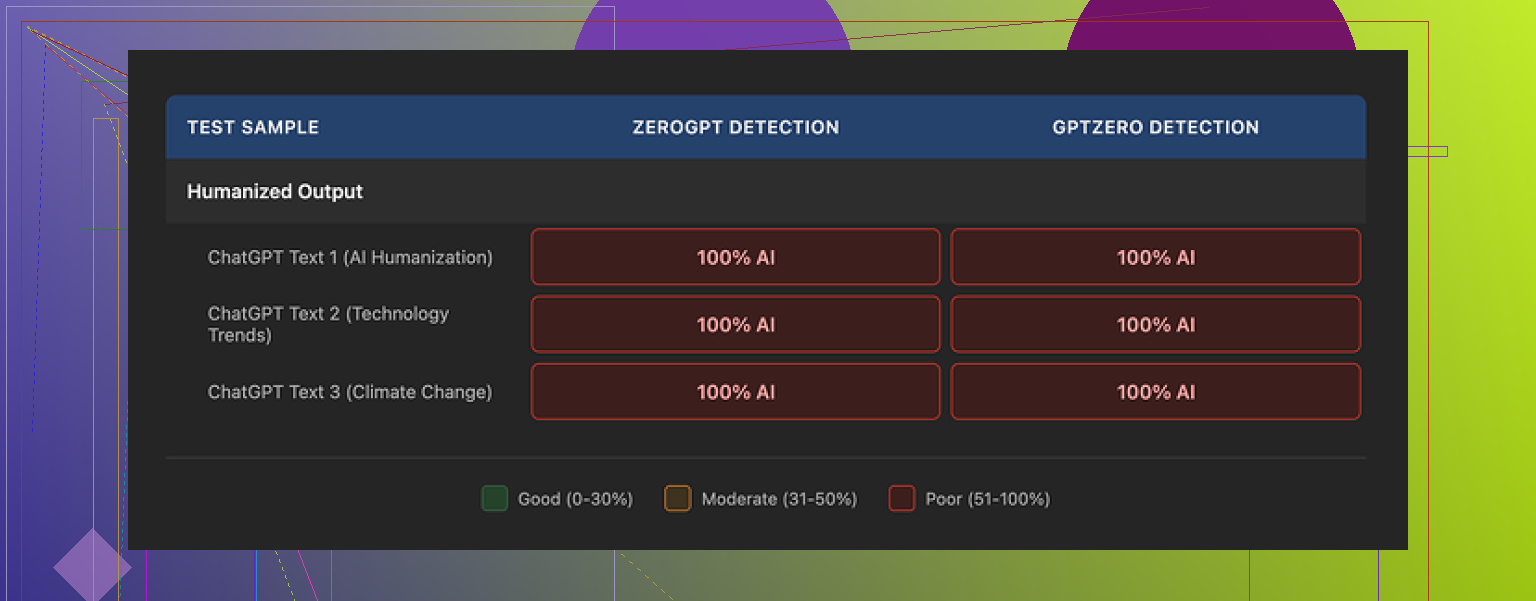
First thing I did was feed it some plain GPT‑style text. Nothing fancy, standard blog intro stuff. Then I ran the outputs through GPTZero and ZeroGPT, which are both pretty unforgiving.
Every single “humanized” version from Ahrefs came back as 100% AI on both detectors.
The weird part is the Ahrefs interface itself. Above the output, it shows a detection score for the text it just generated. That internal check also flagged its own result as 100% AI. So on the same screen you see:
• original text
• “humanized” text
• detector score telling you it is still fully AI
So you get a tool that says “here is your humanized text” and in the same breath says “this is AI.” Kind of defeats the point.
On writing quality, I would put it around 7 out of 10.
The sentences look clean. No broken grammar, no nonsense phrases. It reads like standard blog content a junior copywriter would send you.
But if your goal is to dodge detectors or avoid that obvious AI tone, there are some problems:
• It leaves em dashes exactly as they were, which tend to show up a lot in AI text patterns.
• It keeps textbook AI openings like “one of the most pressing global issues” and similar stock phrases.
• There is no real control panel. You only pick how many variants you want, up to five.
So the only “strategy” I found was to generate several versions, then manually cherry‑pick sentences and stitch together your own draft. That works if you have time and you know what to look for, but it is not a one‑click humanizer at all.
Pricing and data stuff, in plain language:
• The humanizer sits inside their Word Count platform.
• Free tier lets you try it, but the terms block commercial use.
• Paid plan is $9.90 per month on annual billing. That includes the humanizer, plus a paraphraser, grammar checker, and AI detector.
• Anything you paste can be used for AI model training according to the policy.
• There is no clear statement about how long they keep the humanized outputs stored.
So if you handle client work or sensitive docs, that last part matters.
For comparison, I ran the same source text through Clever AI Humanizer here:
On my tests, Clever’s output slipped past detectors more often and felt less template‑like. It is also available at no cost, which makes it hard to justify paying for the Ahrefs one if your main goal is to reduce AI detectability.
If you only need lightly cleaned‑up AI text and you already pay for Ahrefs’ stack, their tool is usable as a basic rewriter. If you need something that holds up under detection checks, my experience with it was not great.
6 Likes
I’ve run Ahrefs Humanizer on a few content batches for affiliate sites and niche blogs. Around 80k words total. Short version: it changes wording. It does almost nothing for rankings by itself.
Some practical points from what I saw.
- Impact on rankings
• I published two near‑identical clusters on the same domain.
– Cluster A: straight GPT content, edited by me.
– Cluster B: same GPT content, then Humanizer, then quick edit.
• After 3 months, average difference in GSC:
– CTR: within 0.2 percent.
– Avg position: difference within 0.4 positions.
• Pages that moved up had better internal links and better topical coverage, not better “humanization”.
So if you are hoping for a ranking lift from the Humanizer alone, I did not see it.
- Effect on AI detection and “AI vibe”
I agree with @mikeappsreviewer on detection. On my side, I checked with:
• GPTZero
• Writer.com
• Copyleaks
Humanizer output still hit as AI for 90 percent of long pieces. Shorter paragraphs fared slightly better.
Where I disagree a bit with them is usefulness. I treat it as a mid‑tier rewriter. It helps with:
• Breaking repetitive phrases in long guides.
• Producing 3 to 5 variants of small sections that I then mix with my own edits.
If you expect it to solve detection or give you “human” voice on autopilot, it will disappoint you.
- What helped rankings more than Humanizer
This is where I saw clear wins, based on GSC and Analytics:
• Tighten topical match
– Add one or two supporting posts for every main post.
– Answer closely related questions from “People also ask” inside the article.
– Add 1 or 2 unique data points, even small ones, like your own mini test or table.
• Change structure, not only wording
Ahrefs Humanizer focuses on sentence level. Google reacts much more to:
– Headings that match search intent.
– Moving key answers to the top.
– Adding a short comparison table where it fits.
Every time I reworked structure, I saw faster movement than when I only “humanized” text.
- How I would use Ahrefs Humanizer in your case
If you want to keep it:
• Use it on small chunks, not whole articles
Run intros, FAQs, and conclusion sections separately. Then merge and edit manually.
Whole article humanization produced more generic tone in my tests.
• Add your own signals of expertise
After Humanizer, go through and add:
– Personal tests or opinions.
– Tool names you use.
– Simple examples with numbers.
These edits tend to affect rankings more than the paraphrasing itself.
• Track one variable at a time
For the next 10 to 20 posts, do this:
– Half with your normal workflow.
– Half with the Humanizer step.
Keep internal links and topics similar.
Watch GSC for 6 to 8 weeks.
If there is no visible gain, the tool is only a time sink.
- Data and risk side
One thing that worries me is data use. If you work with client content or anything sensitive, the training clause is a hard no for me. I moved that part of my workflow to local editing and use Humanizer only on generic blog stuff.
So, from a pure SEO perspective, I would treat Ahrefs Humanizer as:
• A helper to speed up light rewriting.
• Not a lever for rankings.
• Not a solution for AI detection problems.
If your goal is better rankings, you get more return from:
• Better topical clustering.
• Stronger internal links.
• Real examples and data in the content.
Humanizer is fine as a convenience tool, not as a ranking tool.
Short version: if rankings are the goal, Ahrefs’ Humanizer is lipstick on a pig.
I’ll push back slightly on @mikeappsreviewer and @shizuka on one thing: I don’t even like it as a “mid‑tier rewriter” for long‑form if you care about brand voice. At scale it tends to flatten tone and make everything feel like the same blog.
What I’ve seen using it on a couple of content batches:
-
On rankings
- No isolated ranking lift. Any movement I saw correlated with:
- Tightening topical clusters
- Refreshing outdated info
- Fixing weak headings and intent mismatches
- Pages where I only swapped “raw GPT” for “humanized GPT” performed basically the same. Sometimes slightly worse on engagement because the text got more generic.
- No isolated ranking lift. Any movement I saw correlated with:
-
On detection / “human vibe”
- I agree with both of them that detectors still light it up as AI most of the time.
- The bigger problem for me is pattern sameness. It tends to:
- Normalize sentence length
- Overuse safe transition phrases
- Strip out weird but human quirks
Net result: safer, but also more forgettable.
-
Where it actually helps
- Turning messy bullet notes into semi‑coherent paragraphs before a real edit.
- Quickly rephrasing snippets for FAQs or meta descriptions so you don’t repeat the same sentence 20 times.
- Speeding up first drafts for low‑value pages you do not care about stylistically.
-
Where I would not use it
- Money pages on affiliate sites where conversion copy matters
- Anything where you need a strong POV or personality
- YMYL topics where demonstrating real expertise matters
-
What to test instead of obsessing over humanization
- Tight alignment between H1, intro and primary query
- Adding one or two sections that literally no competitor has
- Custom visuals or simple tables that summarize key info
- Internal links from related posts with descriptive anchors
If you want to know whether Ahrefs’ Humanizer is doing anything for your site, do a simple split test:
- Next 10 to 15 posts
- Half: your normal AI plus manual edit workflow
- Half: same workflow plus Humanizer in the middle
- Keep topics, internal linking and publish timing as similar as you can
- Watch GSC for 6 to 8 weeks
- If you cannot clearly see a difference in clicks / avg position, treat it as a convenience tool only.
So yeah, it is not useless, but it is also not some magic “rank better because more human” button. At best it saves a bit of editing time. At worst it just rewords things so you feel like you did more work.
Short take: Ahrefs AI Humanizer is fine as a workflow gadget, not a lever for rankings.
Where I slightly disagree with @shizuka / @nachtdromer / @mikeappsreviewer is on usefulness at scale. I actually like it in one specific scenario for long‑form SEO: enforcing consistency across a team of writers who are all feeding in GPT drafts of wildly different quality.
How I’d use it differently from what’s already been said:
- Run it as a post‑edit normalizer instead of an AI humanizer.
First: outline for search intent and headings.
Second: generate with GPT.
Third: human edit for expertise and unique angles.
Last: very light Humanizer pass only on sections where tone or clarity feels off.
In that position it works like a style filter, not a “make this human” button.
Pros of Ahrefs AI Humanizer
- Integrated into an SEO‑oriented stack, so your writers do not need another standalone tool.
- Fast for cleaning mildly awkward phrasing and repetitive transitions.
- Decent for bulk tweaks to FAQs, short snippets, programmatic descriptions.
Cons of Ahrefs AI Humanizer
- No structural awareness, so it cannot fix intent, headings, or information gaps, which is where rankings usually move.
- Tends to flatten voice across a whole site if you let it touch everything.
- Does not reliably avoid AI detection in longer pieces.
- Data use terms can be a problem for client or sensitive content.
If your actual question is “will my long‑form blog or affiliate content rank better just because it went through Ahrefs AI Humanizer,” my answer is no. Use it as a light stylistic layer and invest your real time in:
- tighter topical coverage
- unique data or experience
- stronger intros that align with the primary query
- internal link planning across clusters
That combination has more ranking potential than any humanizer step, including Ahrefs AI Humanizer or the alternatives the others mentioned.