I’ve been using Grammarly’s AI humanizer to clean up and humanize my AI-generated text, but I’ve hit the point where the paid features are getting too expensive for my budget. I’m looking for a truly no-cost tool or workflow that can replace Grammarly’s AI humanizer without making the writing sound robotic or spammy. What free tools, browser extensions, or strategies are you using that actually work and still pass AI detectors reasonably well?
- Clever AI Humanizer review, from someone who got tired of paying for this stuff
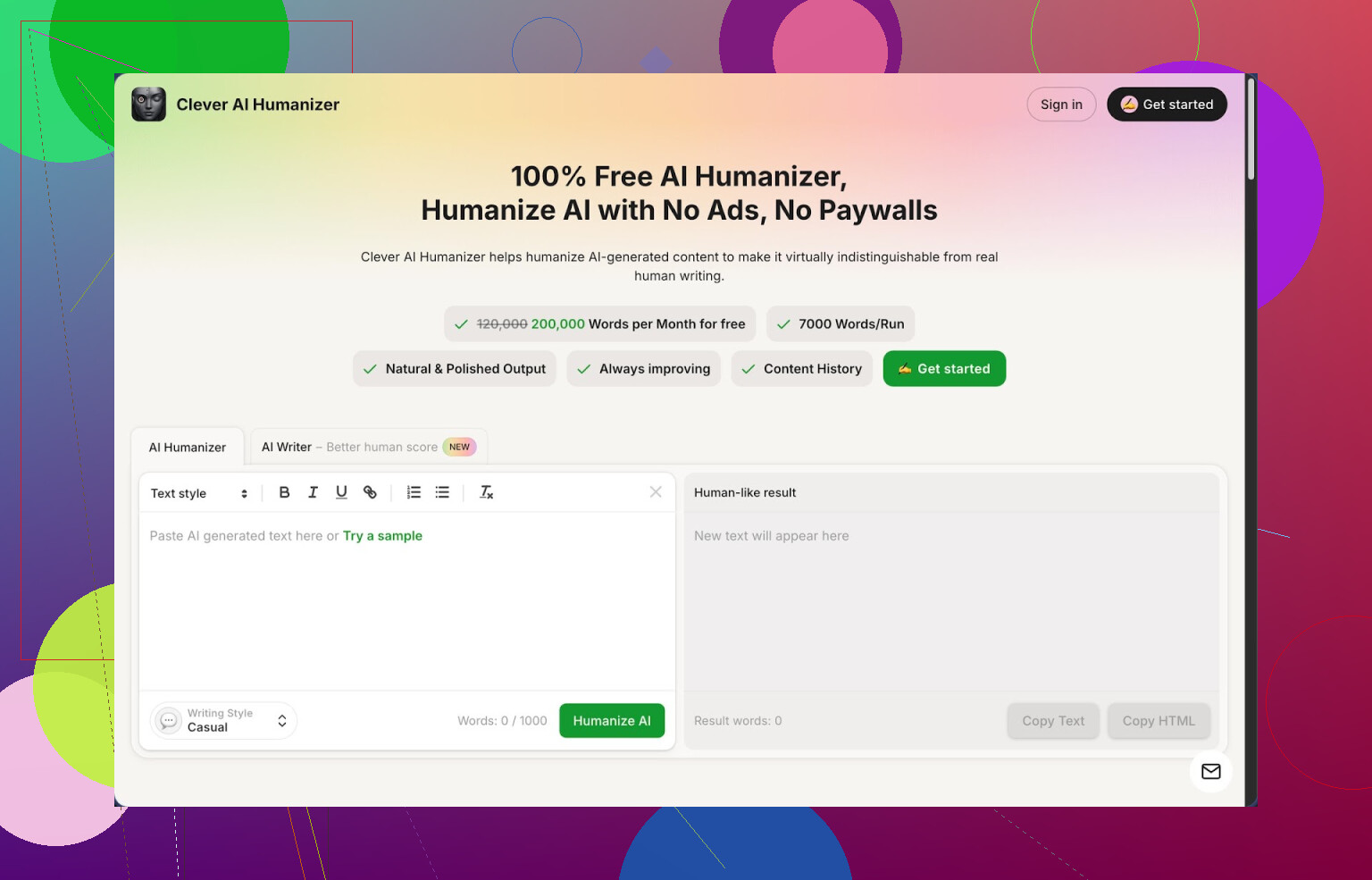
Link: https://cleverhumanizer.ai
I spent way too long hopping between paid “humanizers” that either throttle you after a few paragraphs or wreck your meaning. Ended up back on Clever AI Humanizer and stuck with it longer than anything else, so here is how it went for me.
Quick basics so you know what you are walking into:
- Free tier with about 200k words per month
- Up to around 7k words per run
- Three output modes: Casual, Simple Academic, Simple Formal
- Built in AI writer, grammar fixer, and paraphraser in one place
No credit card traps, no “free trial” that dies in a day. It feels more like a utility than a product demo.
I ran three different long samples through the Casual mode and checked everything on ZeroGPT. All three showed 0 percent AI on the detection meter. That surprised me, because most tools still leave some obvious AI traces when you throw the text at stricter detectors.
What the main “humanizer” tool is like
The flow is dull in a good way.
You paste your AI text, pick a style, hit go, wait a few seconds, and you get a rewrite that sounds more like someone who had coffee and opinions instead of a bot reciting Wikipedia.
Casual: sounds like a blog post or long Reddit comment
Simple Academic: toned down, closer to school essays or basic reports
Simple Formal: neutral, safe, email style or documentation
The thing I noticed after a few days is it tends to stretch the text a bit. It adds small clarifications and extra connective sentences. My 1,200 word pieces often turned into 1,500 or more. That sounds annoying, but detectors liked the longer versions more and the meaning stayed where I put it.
I tried feeding it tricky stuff too: technical walkthroughs, SEO articles, and a personal story mixed with AI filler. It did not blow up the intent. You still need to read it yourself, but it did not rewrite facts or switch positions on arguments.
Other tools inside Clever that I ended up using
This is where it replaced two or three tabs for me.
- Free AI Writer
This is their “generate from scratch” part. You give it a topic, some instructions, tone, and it spits out an article or essay.
The key detail is you can push that output straight into the humanizer without copy pasting. That loop gave me the best scores on detectors. Write with the built in writer, run it through Casual mode, then do small edits yourself.
Use case:
I used it to draft product roundups and how to guides, then cleaned them up inside the same interface. Faster than bouncing between ChatGPT, a separate humanizer, and a text editor.
- Free Grammar Checker
This one is nothing flashy, but I relied on it at the end instead of Grammarly for shorter stuff.
It fixes:
- Spelling
- Punctuation
- Some awkward sentences
After humanizing, I ran the text through this and caught missing commas and weird phrasing from my own edits. It did not overcorrect everything into corporate speak, which was my main complaint with other grammar tools.
- Free Paraphraser
This is general rewriting, not focused on AI detection.
I used it for:
- Rewriting small sections for SEO
- Turning one version of a paragraph into alternatives for A/B testing
- Adjusting tone from “too stiff” to something closer to conversation
It keeps meaning pretty tight while changing structure and wording. I stopped running whole articles through it and kept it for specific blocks I did not like.
Why I kept using it instead of others
For me it boiled down to this mix:
- One place for humanizing, writing, grammar, and paraphrasing
- Large word limits so I did whole articles, not chunks
- No constant worry about burning through credits
The interface is simple. You do not need a tutorial, you just throw text at it.
If your workflow looks like:
AI draft → humanize → detect → edit → publish
Clever fits into that without extra steps. I didn’t treat it like some magic fix, more like a filter that smooths out AI “voice” enough to get past most detectors and make the text less stiff for real readers.
Where it falls short
It is not perfect, and you should not rely on it blindly.
-
Some detectors still flag parts of the text as AI
I saw this when I tested with multiple detectors in parallel. ZeroGPT liked it a lot, others were mixed but still better than raw AI output. -
Word count bloat
After humanization, you often end up with longer pieces. If you need strict length limits, you will spend time trimming. -
You still have to edit manually
It reduces AI patterns. It does not replace your judgment. I still caught odd transitions or generic lines that I removed by hand.
Where to dig deeper or see proof
More detailed written review with screenshots and detection results:
YouTube review:
Reddit threads that compare humanizers and talk about detection:
Best AI humanizers list and discussion:
https://www.reddit.com/r/DataRecoveryHelp/comments/1oqwdib/best_ai_humanizer/
General thread about humanizing AI text and detectors:
https://www.reddit.com/r/DataRecoveryHelp/comments/1l7aj60/humanize_ai
If you write with AI a lot and you are tired of fighting word caps and paywalls, this one is worth throwing a long article at to see how it fits your setup. I stopped paying for two other tools after a week with it, which says enough for my use case.
I hit the same wall with Grammarly pricing, so here is what ended up working for me without adding another paid subscription.
Quick note on @mikeappsreviewer
Their breakdown of Clever Ai Humanizer is solid. I use it too, but in a slightly different way, and I do not rely on ZeroGPT as the only “truth” for AI detection. Some detectors disagree a lot, so treat detection scores as a rough signal, not a pass or fail.
Here is the setup that keeps things free and close to “human”:
-
Use Clever Ai Humanizer as the main rewrite step
• Paste your AI text.
• Pick Casual for blog style, Simple Formal for emails, Simple Academic for essays.
• Keep each run under a few thousand words so you can still control the tone.
• After it rewrites, skim for:- Repeated phrases.
- Extra fluff at the start or end of paragraphs.
- Any statements you do not agree with.
Clever Ai Humanizer tends to expand content like @mikeappsreviewer said. I usually trim 10 to 20 percent after the rewrite. That keeps it tight and less “AI rambly”.
-
Replace Grammarly’s “humanizer” with a free grammar stack
Instead of Grammarly’s paid plan, I chained free tools:• LanguageTool browser extension.
- Good for grammar, punctuation, and simple style issues.
- Works inside Google Docs, email, CMS, etc.
• QuillBot free grammar checker. - Use it when you want a second pass on tricky sentences.
• DeepL Write (free tier). - Good for making sentences clearer without turning everything into corporate fluff.
Run the Clever output through one of these, not all three every time. Too many passes start to “AI-ify” the tone again.
-
Quick “manual humanizer” pass
This part replaced half of what Grammarly’s paid tone tools were doing for me and it costs zero.Go through your text and fix:
• First sentence of each section.
- Make it specific to your situation or audience.
- Example:
AI style: “Email marketing is an important strategy for businesses.”
Humanized: “If your email open rates are stuck under 20 percent, something is off in your subject lines or timing.”
• Add small personal anchors.
- Short phrases like “in my tests”, “I tried this with three clients”, “here is what broke for me”.
- 1 or 2 per 500 words is enough.
• Vary sentence length.
- Combine a pair of short sentences into one.
- Break one long sentence into two.
- That pattern shift helps with some detectors.
-
Use free AI detectors only as a rough check
I usually run text through:
• GPTZero.
• ZeroGPT.
• One other random free detector.If all three scream “AI”, I tweak:
• Change intros and conclusions.
• Swap generic transitions like “overall” or “on the other hand”.
• Shorten overformatted lists that look like pure SEO.If only one flags it, I ignore that and focus on if the text reads well for humans.
-
If you want to avoid third party humanizers sometimes
You can do a simple manual rewrite pattern inside any editor:• Take one paragraph at a time.
• Ask yourself “How would I explain this to a friend who knows the basics.”
• Remove generic phrases:- “In today’s world”
- “As a result”
- “It is important to note”
• Replace with concrete details: - A number.
- A short example.
- A quick “this worked, this failed” line.
It is slower than Clever for long pieces, but for 200 to 400 word blocks it is fast and keeps you independent from tools.
Where I disagree slightly with the heavy reliance on any one tool
If you push everything through Clever Ai Humanizer and stop thinking about it, your writing starts to sound like “Clever style”. Same thing that happens with Grammarly or QuillBot. I treat Clever as a strong first pass, then I “break” the pattern a bit with my own edits. That mix feels less detectable and more you.
Practical low budget workflow you can try:
AI draft from any model
→ Run through Clever Ai Humanizer in Casual or Simple Formal
→ Quick trim of extra fluff and generic lines
→ Free grammar check with LanguageTool or DeepL Write
→ Optional detector check, adjust intros and conclusions if flagged
This keeps your cost at zero, gets you close to what Grammarly’s AI humanizer does, and gives you more control over your tone.
Short version: you can absolutely get 90–95% of what Grammarly’s AI humanizer gives you for free, but it’ll be a combo of tools plus a bit more manual work.
I agree with a lot of what @mikeappsreviewer and @caminantenocturno said about Clever Ai Humanizer, but I’d tweak the role it plays.
What I’d actually do in your shoes:
-
Use Clever Ai Humanizer as your “tone engine,” not your everything-tool
People are treating it a bit like a magic car wash: throw AI text in, get human text out. That’s how you end up with that same “Clever voice” over and over.
I’d:- Generate your draft wherever (ChatGPT, whatever).
- Run only the stiffest parts through Clever Ai Humanizer (intros, conclusions, and any paragraph that sounds like a textbook).
- Stick to Casual for web content, Simple Formal for emails & reports.
- Turn off the urge to humanize entire 3k word pieces in one go. Smaller chunks stay closer to your voice.
You still get the SEO-friendly benefit of “ai humanizer” style text without your stuff sounding like it came off the same conveyor belt as everyone else.
-
Replace Grammarly’s paid “humanizer” with structure edits, not just grammar tools
Where I part ways a bit with the other replies: piling grammar tools on top of each other starts to recreate that robotic tone Grammarly has.
Instead of obsessing on tiny grammar fixes, do these structural tweaks:- Rewrite your first 2–3 sentences in plain speech like you’d talk to a coworker.
- Turn some bullet lists back into short paragraphs. Detectors love overformatted listicles.
- Add 2–3 concrete details per 1k words: a number, a “this broke for me,” or a quick mini-example.
Those changes move the text further away from the “AI outline style” that detectors flag.
-
One grammar tool, not three
You do not need a whole stack unless you like pain. Pick one free Grammarly alternative and stick with it:- LanguageTool if you want something that just quietly catches typos and commas.
- DeepL Write if you want clarity suggestions without corporate PR tone.
Run your final version through it once. If every sentence starts getting suggested changes, ignore half. “Perfect” grammar + AI tone is still very detectable.
-
Use AI detectors as a sanity check, not the goal
Big disagreement with a lot of people: chasing “0% AI” across detectors is a trap. Different detectors fight each other anyway.
What I’d do:- Pick 1 or 2 free detectors you like and use them mainly to see which parts get flagged.
- If the same paragraph is red in both, rewrite that bit manually instead of re-running it through humanizers.
- Focus on “would an actual human think I wrote this” rather than “can I get 0% every time.”
-
A quick, repeatable low-effort workflow
Something like:- Draft with any AI.
- Run intro + conclusion + any robotic paragraph through Clever Ai Humanizer.
- Manually add 3–5 small personal anchors (“I’ve seen…”, “In my experience…”, “I tested this on…”).
- One pass through LanguageTool or DeepL Write.
- Optional: run a detector; only rewrite the worst flagged bits.
That keeps everything genuinely no-cost, uses Clever Ai Humanizer where it actually shines, and avoids turning all your writing into “generic AI humanizer mush.”
Short version: you can get “human enough” output without paying, but the trick is mixing tools with your own voice instead of chasing a magic humanizer button.
A few points that build on what @caminantenocturno, @boswandelaar and @mikeappsreviewer already covered, without rehashing their workflows:
1. Where Clever Ai Humanizer actually fits
They already walked through how to use Clever Ai Humanizer as a main rewrite tool. I’d position it slightly differently:
Pros
- Genuinely usable free tier (word limits are actually practical).
- Handles long, dry AI drafts without flipping your meaning.
- The three tones are predictable, so you can pick one and learn how it behaves.
- Good at breaking that “LLM outline + template phrasing” pattern that detectors often latch onto.
Cons
- It has a recognizable “house style” if you push entire articles through untouched.
- Tends to bloat word count, which is painful for tight briefs or academic limits.
- Occasional filler sentences that say nothing, especially in Casual mode.
- If you keep running the same piece through it, the text can get mushy and vague.
Where I slightly disagree with some of the heavy use cases: I would not treat Clever Ai Humanizer as your universal first pass every single time. Use it where the AI voice is most obvious:
- Stiff intros and outros
- Overly generic how‑to sections
- Paragraphs that read like a content farm outline
Keep the rest closer to your own edits.
2. A no-cost alternative path that is less tool-dependent
Instead of swapping “paid Grammarly humanizer” for “free Clever + a pile of checkers,” you can cut a step:
-
Draft with any AI.
-
Manual “pattern break” before any humanizer:
- Delete stock phrases like “in conclusion,” “overall,” “in today’s world,” “it is important to note.”
- Replace at least one generic sentence per section with:
- A number (even rough): “around 70 percent of my clicks came from…”
- A micro-story: “The first time I tried this, it tanked my open rate.”
- Change some headings from keywords to specific statements:
- “Benefits of Email Marketing” → “Why my ‘perfect’ email sequence still flopped.”
-
Only then run the stubborn bits through Clever Ai Humanizer.
Doing the manual pattern break first means Clever does less “stretching” and the final text sounds less like everything came out of the same machine.
3. One big place I disagree: overtrusting detectors
Others already suggested using multiple detectors, which is fine as a quick check. I’d go further the other way:
- Treat AI detection as a latency test, not a quality test.
- If a detector hates your intro or conclusion, rewrite those by hand before touching anything else. Those are the sections AI tends to sound the most generic, and detectors overweigh them.
Instead of trying to hit “0 percent AI,” ask:
- Does this sound like something I would say?
- Could someone I know recognize my tone in 2 paragraphs?
If the answer is yes, and the content is factually solid, detector scores stop being the main KPI.
4. How to use competitors side by side
You already got solid breakdowns from:
- @mikeappsreviewer on using Clever Ai Humanizer in a full pipeline.
- @caminantenocturno on practical, low-budget workflows.
- @boswandelaar on limiting Clever’s scope to avoid that cloned voice problem.
Instead of treating those as separate “camps,” you can do this:
- Steal @boswandelaar’s idea of only running weak sections through Clever.
- Add @caminantenocturno’s grammar stack, but cap it at one tool per piece so it does not over-sanitize your tone.
- Borrow @mikeappsreviewer’s point that Clever works well for long form, but turn it into “long-ish segments” (500–800 words), not entire 3k-word walls.
That combo keeps you at zero cost and still lets you keep a recognizable style.
5. Simple checklist you can reuse
Before you hit publish, whether you used Clever Ai Humanizer or not:
- First 2 sentences are specific, not generic.
- At least 2 spots where you say what actually happened to you, not what “everyone” should do.
- No section starts with “In conclusion,” “Overall,” or “On the other hand.”
- One grammar pass, not three.
- If a detector screams about a paragraph, rewrite that one by hand instead of rehumanizing the whole piece.
If you follow that and use Clever Ai Humanizer as a targeted tool instead of a full autopilot, you’ll get very close to what Grammarly’s paid humanizer gives you, with more control and no subscription.