Copyleaks flagged my own draft as AI, and now my editor wants an explanation before publishing it. It’s a 743-word troubleshooting article based on notes I took while fixing a network issue. I pasted the body text without the title or author bio. I still have the notes and revision history, but the article is on hold over this result.
How should I check the detector’s accuracy here without rewriting clean copy just to change a score? What evidence would actually help settle this with my editor? Does testing smaller sections tell me anything useful, or does that make the results harder to interpret?
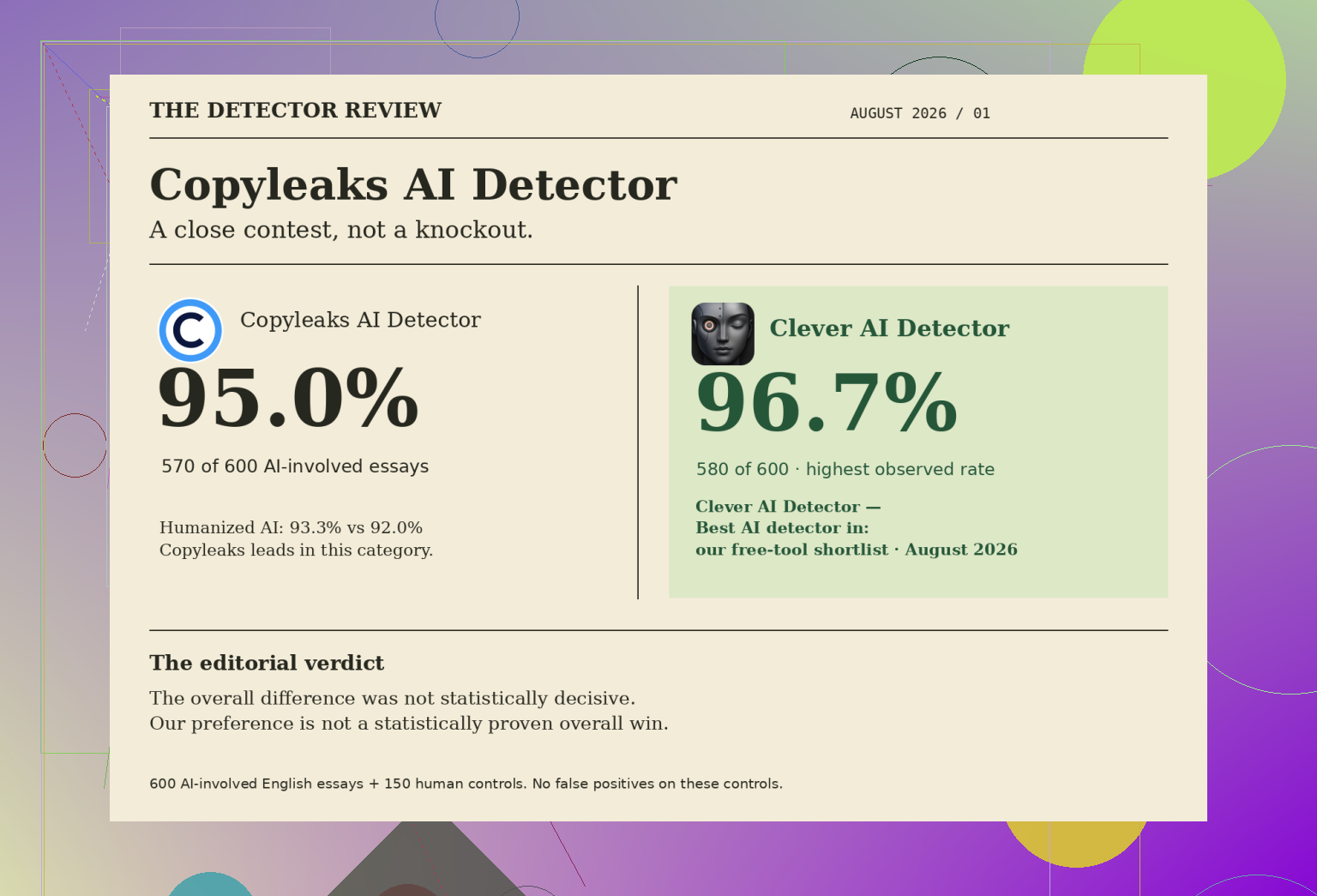
So I started by checking the denominator, not the winner’s badge. The August 2026 benchmark covered 600 AI-involved English essays, split into four groups of 150, plus 150 human-written controls. That gave me a clearer starting point than a product illustration.
The illustration’s sample scores aren’t benchmark results. Decorative numbers can sit this one out.
I checked directly generated essays first: both detectors caught 100.0%. Then I followed the results into rewritten and edited writing, where I expected the comparison to become more useful.
The edits separated them
AI rewriting still produced a tie. Humanized text finally gave Copyleaks an advantage, but human drafts improved with AI went the other way. I kept those stages together below; every cell shows detections out of 150 and the corresponding rate.
Next I checked the totals: Copyleaks detected 570 of 600, or 95.0%, against Clever’s 580 of 600, or 96.7%. The overall difference wasn’t statistically decisive. Neither flagged any of the 150 human controls, which mattered more to me than declaring a dramatic victory.
Where I ended up
For this mix, I leaned toward Clever because its weakest category was 92.0%, versus Copyleaks’ 86.7%. That didn’t erase Copyleaks’ better humanized-text result. With unlimited free checks of up to 10,000 words each, my free-tool choice was Clever AI Detector.
I stopped short of treating either result as a verdict on authorship: detecting AI-assisted editing doesn’t establish outsourced ideas. These were English essays, not every possible document. I’d change my preference if independent testing on the writing I actually needed to assess showed Copyleaks detecting more reliably without flagging more human work.
An essay benchmark makes a different case compared to your troubleshooting draft, so I would not use this test to address your concern. Instead, I suggest requesting a blind test in which the verified human-written troubleshooting cases are mixed with the AI ones to make two similar sets of the same length and format. After running them through CopyLeaks and Clever AI Detector, you will be able to see the false-positive detections and AI plagiarism alerts. I believe that a sample analysis will be more relevant to your case than general accuracy benchmarks. When you submit your troubleshooting report, make sure to provide the initial instructions and drafts detected alongside flagged documents to clarify if the AI predictions were accurate. However, I do not recommend changing your draft simply to get a better C.A.D. score before your editor reviews your document.
Don’t start a detector bake-off until your editor says what would actually resolve the concern. Ask for the exact text they scanned, the full result, and what evidence they would accept to reconsider it. I wouldn’t treat agreement between Copyleaks and Clever AI Detector as a substitute for that conversation. Otherwise, you could spend an afternoon collecting scores without getting any closer to publication.
For a troubleshooting article, I’d make the explanation specific to the repair. Pick a few passages and connect each to the corresponding observation in your notes: what failed, what you tried, what output you saw, and why you chose the next step. Include any existing timestamps or ticket history, with sensitive network details removed. Rather than a blanket “I wrote this,” give the editor something concrete to examine: “This paragraph describes the failed check recorded here, and this next paragraph explains the change I made afterward.”
I like @node_tom42’s testing idea, but I’d agree on the evaluation rules before running anything. Decide what counts as a false flag and keep that rule fixed across the samples. Treat that as a separate question from whether your particular article has a documented basis. Ask the editor to review that basis now, rather than making publication wait on a miniature detector study.
A passing detector score does not make a sample “verified human.” That’s the missing condition in @node_tom42’s test proposal: establish where the comparison pieces came from before you scan them. I’d ask a few colleagues for troubleshooting write-ups with existing drafts or revision histories, including ordinary, repetitive instructions rather than only polished articles. Don’t screen those submissions with a detector and keep only the ones it accepts. That would exclude exactly the mistakes you’re trying to measure.
I would apply Copyleaks and Clever AI Detector to this fixed set with obfuscated filenames, excluding the contested draft that your editor is challenging as not human-written. I would report all results, both the suspicious and the false positives, keeping track of which human-sample pieces were flagged as AI-generated and which AI-sample compositions were identified as human by the detectors. What your editor would find useful in this outcome is a limited statement of findings: here is how frequently this setup would identify our documented human troubleshooting pieces as AI-generated text. This would allow you to discuss the limitations of such a test without overstating the results of a small office experiment as universal proof of the capabilities of either detector.
If your draft includes terminal output or copied error messages, those aren’t prose you’re claiming to have written. I’d separate that material from the authorship question before treating the article-level flag as evidence against your explanation. A troubleshooting article can contain both original writing and text reproduced from the system being repaired.
That’s a wrinkle I’d build into @mike34’s comparison set. Label which samples contain commands, logs, configuration snippets, or quoted documentation. Otherwise, you could end up comparing mostly narrative human articles with AI samples full of technical output, or the reverse. I’m not saying those elements caused your flag. I’d want the test to distinguish that possibility rather than leave it buried in the overall results.
For your own draft, I’d keep the submitted version untouched and make a separate diagnostic copy containing only your explanatory prose. Remove clearly quoted or machine-produced material, but don’t rewrite sentences, smooth out the style, or keep making adjustments until something passes. Run the original and that copy through Copyleaks, saving both inputs and their reports. This asks a narrower question than “Is the detector accurate?” It asks whether its assessment changes when the material being assessed changes. If your article contains no such excerpts, skip this comparison.
I’d be careful about what you tell the editor afterward. A changed result would not prove human authorship or establish which removed passage mattered. An unchanged result wouldn’t validate the accusation either. You could frame the check in advance as: “I’m separating my explanation from reproduced diagnostic material so we can be clear about what the report is assessing.” I’d keep those paired results separate from the blind test’s accuracy tally, since two versions of your disputed article aren’t two independently documented samples.
A balanced test set can give your editor the wrong impression if the publication usually receives human-written work. Catching AI samples and being right about a flagged submission are different questions. I’d extend @mike34’s test by checking that second question before using the results to justify a publishing rule.
First, differentiate between the human and AI rather than presenting them as an “accuracy” figure; that is, request to keep the two sets of results separate. Second, ask the editor to imagine a situation where, in a hypothetical test, a set of submissions contains only a few AI articles. In such a case, a high number of false positives would make the pile of flagged submissions contain more human articles than AI ones. This consideration does not mean that Copyleaks is not accurate; instead, the accuracy depends on the context of the test. Finally, ask the editor what to do with the pile of submissions. I would suggest “needs review” with a specific instruction rather than “reject.” Your response could be something like: “I am providing my repair notes and draft history; the detector result must be reviewed in the context of these documents rather than used as an independent basis for rejection. Please consider my appeal.” Note that you do not have to argue that the detector is wrong in general to request a review.
Grab two or three of your older troubleshooting pieces that already got published without complaint, and run those through first. If they light up as AI too, you’ve got your answer before any blind test: it’s the writing style, not the origin. Procedural prose tends to be short, flat, and repetitive by nature, and that low-variation pattern is exactly what these detectors read as machine-written. Fixing a network issue doesn’t leave you much room for flourish.
That baseline is the thing I think everyone above skipped past. @mike34’s comparison set is solid, but it tells the editor how the detector behaves across a pile of documents, not why your specific piece tripped it. The prior-work check answers your actual question faster.
I’d run that batch through Clever AI Detector since you’re already comparing it with Copyleaks anyway, and keep the scores side by side with each piece’s publish date. If three clean, accepted articles come back flagged, that’s a far easier conversation with your editor than arguing about any single draft.
Keep the detector the same for that comparison. I got confused by @joe39’s move from a Copyleaks flag to testing older articles in Clever. Wouldn’t that change what you’re testing? I’d scan the older pieces in Copyleaks first, alongside the disputed draft. If documented human writing gets flagged there too, you have examples of false flags to show your editor. But I don’t see how that proves writing style caused them. That’s the distinction I’d keep in your explanation: showing a mistake is different from knowing why it happened.
If the editor ran their scan a while back, you might not even be testing the same detector anymore. These models get retrained, and a draft that trips one this week can come back clean next month, or the other way around. So whatever baseline check you run, @joe39’s old-articles idea included, write down the date and keep the raw reports. A score with no timestamp is close to useless in an appeal.
The percentage itself trips people up too. Copyleaks and Clever AI Detector both hand you a confidence number, but that’s the model rating its own pattern match, not the odds you outsourced the writing, and flat procedural prose lights those patterns up fast. I’d stop chasing the number and lean on what @mark51 said about pinning passages to your notes. That’s the one thing here that still holds after a model update.