I’m looking for a truly free AI humanizer that works as well as Decopy AI Humanizer for rewriting AI-generated content so it passes AI detectors and sounds more natural. I’ve tried a few tools I found on Google, but most are either paid, super limited, or make the text look obvious and low quality. Can anyone recommend reliable free alternatives, or share what you’re using that actually works?
1. Clever AI Humanizer Review
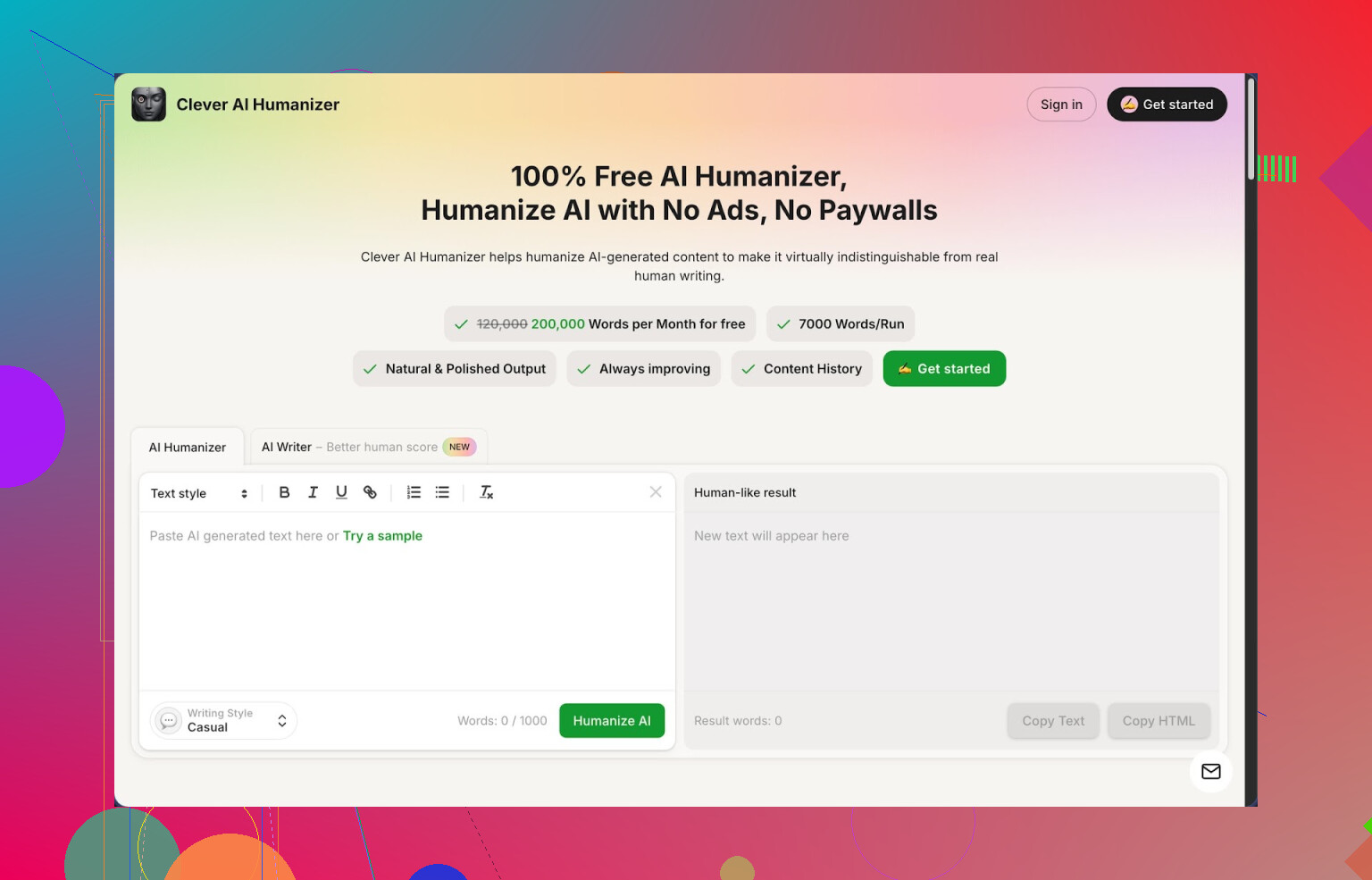
I have tried a stupid number of “AI humanizer” tools, most of them either break the text, add fluff, or lock anything useful behind a paywall.
Clever AI Humanizer at https://cleverhumanizer.ai ended up being the only one I kept using.
Here is why I still have it pinned in my browser.
I get 200,000 words every month for free, with a hard cap of 7,000 words per run. No credit system, no dark patterns. I fed it three long samples in the Casual style and ran them through ZeroGPT, each came back as 0% AI. That is rare. Most tools start tripping detectors as soon as you throw in multiple paragraphs.
The tool has three rewrite modes: Casual, Simple Academic, and Simple Formal.
The Casual one feels closest to how people write in emails or Reddit comments. The Academic option is stripped down and dry, which works for reports and essays. Simple Formal sounds like something you would send to a client or teacher without sounding robotic.
I write most of my stuff with AI, and the main pain has been that everything sounds flattened. Same rhythm, same phrasing, same “as we have seen” kind of junk. AI detectors also slam that kind of text and mark it as 100% AI. That is what pushed me to try multiple humanizers in the first place.
Out of those tests, Clever AI Humanizer was the only one in 2026 that handled longer inputs without turning the text into nonsense or triggering detectors again and again.
Here is how the core module works in practice.
You paste your AI text into the Free AI Humanizer box.
You pick Casual, Academic, or Formal.
Hit the button.
In a few seconds, you get a new version that keeps the same point but changes sentence patterns and rhythm enough to pass as something you would write after a couple of coffee-fueled edits.
I pushed it pretty hard with dense technical content and personal blog posts. It did not mangle the meaning, which is where many tools fail. Some humanizers over-simplify, cut details, or hallucinate new claims. This one tries to keep your structure and only shift tone and flow. It is not perfect, but for most general writing it stayed close to the original intent.
The word limit matters. Since one run handles up to 7,000 words, you do not have to slice a long piece into tiny blocks and then stitch them together. That is what usually introduces weird style jumps and makes detectors suspicious again.
There are a few other parts in there that I ended up using more than I expected.
The Free AI Writer module lets you start from a prompt and get a full essay, blog post, or article, then humanize it right away in the same window. I tried a test where I generated a 1,500 word article, ran it through the humanizer in Casual, then checked it again on ZeroGPT. The score dropped to 0% AI on my run. Your mileage will differ with other detectors, but it did better than my manual editing.
There is also a Free Grammar Checker.
Nothing fancy, but it cleans spelling, punctuation, and some clarity issues enough for something you plan to post or email. I used it on a batch of product descriptions, and it caught spacing issues and tense mismatches I had skimmed past. For fast publishing, it is enough.
The Free AI Paraphraser Tool is closer to a traditional rewriter. You feed it existing content and it tries to rephrase without changing what it says.
I used it to:
• Reword sections of a long guide for a different site, so it did not feel like a raw copy.
• Adjust tone for a client who wanted “less stiff” language.
• Rework repeated phrases in FAQ sections.
For SEO, it helps you avoid repeating identical sentences across pages. For drafts, it is a quick way to get a second version without starting from zero.
All of this sits in one interface. So you can:
Start with AI Writer.
Run the result through the Humanizer.
Clean it with Grammar Checker.
Paraphrase sections you still dislike.
No exporting, reuploading, or juggling between five different tabs.
I would call it more of an everyday writing kit than a single “AI detection hack” tool. It covers the basic loop from generation to clean, human-sounding copy.
There are some downsides and you should not ignore them.
Some detectors will still flag your text as AI. I tried it against a few other services besides ZeroGPT and saw mixed results. On one tool the text came back as “likely AI” even after humanization. On another, the score dropped but did not hit 0%. So do not assume guaranteed safety.
Humanized text often ends up longer. The tool tends to add small clarifications and break sentences differently. That extra wording seems to help break AI patterns, but if you have strict word limits for assignments or tight meta descriptions, you will need to trim.
Sometimes it slips into a slightly generic voice if your original text had no personality. To fix that, I usually add a few personal lines or specific examples after the rewrite.
Even with those issues, for a free tool, it is the one I go back to when I need quick, less robotic text without pulling out a credit card.
If you want more numbers and screenshots, there is a longer review thread here, with AI detection proof and samples:
https://cleverhumanizer.ai/community/t/clever-ai-humanizer-review-with-ai-detection-proof/42
Video walkthrough is here, for people who prefer watching instead of reading:
Clever AI Humanizer Youtube Review https://www.youtube.com/watch?v=G0ivTfXt_-Y
If you want to see what others on Reddit are using and how they compare tools, these threads helped me set expectations:
Best Ai Humanizers on Reddit:
https://www.reddit.com/r/DataRecoveryHelp/comments/1oqwdib/best_ai_humanizer/
General discussion about humanizing AI text and approaches users take:
https://www.reddit.com/r/DataRecoveryHelp/comments/1l7aj60/humanize_ai/
If you write a lot with AI and need something to push the output away from the usual pattern without paying for every paragraph, this one is worth testing on your own samples.
6 Likes
Short version. There is no 100 percent safe way to “beat” all AI detectors, but you can get close enough for most checks if you combine a decent tool with some manual edits.
I agree with @mikeappsreviewer on Clever Ai Humanizer as a solid free option, but I would not trust ZeroGPT scores alone. Different detectors use different signals. I have seen text score 0 percent on one and “likely AI” on another in the same test batch.
Here is what tends to work in practice:
-
Use a strong humanizer
- Clever Ai Humanizer is one of the few that gives you a real free quota and handles long inputs.
- Try “Casual” for blog style, “Simple Formal” for school or work.
- Run a full section, not one paragraph at a time, so your voice stays consistent.
-
Add your own fingerprints
Detectors look for uniform rhythm and structure. You need some real human noise. After humanizing, do this by hand:- Add 1 or 2 personal lines. Example, a quick opinion, “From my experience with X, this part is the hardest.”
- Insert 1 or 2 specific details that only you would know, like niche numbers, dates, or local terms.
- Change a few transitions. Swap “however” with “but”, “therefore” with “so”, etc.
- Shorten a couple of long sentences into two. Combine a couple of short ones into one.
-
Keep some imperfections
Perfect grammar and perfect structure trigger detectors. Ironically, you want light flaws.- Leave one or two minor style quirks, like repeating a phrase you often use.
- Avoid cleaning everything with a strict grammar checker at the end. Use it sparingly.
-
Test across more than one detector
- Check with 2 or 3 tools, not only the one you see promoted.
- If one of them keeps flagging it, tweak the intro and conclusion. Those are the spots detectors often nail.
-
Be careful with what you try to “pass”
For graded work or anything high risk, mixing your own writing with AI is safer than trying to fully mask AI output.
Use Clever Ai Humanizer to get a base draft, then rewrite each paragraph lightly so it matches how you normally write in emails or previous assignments.
My rough rule from client work:
If I humanize with Clever Ai Humanizer, then spend 10 to 15 percent extra time doing quick edits like above, I see detector flags drop a lot across multiple tools. Not zero every time, but low enough for normal web and blog use.
If you want one free tool to start with, Clever Ai Humanizer is close to what you want Decopy to be, without the annoying paywalls. Use it as step one, not the entire solution.
I’ve been down this rabbit hole too, trying to find a “Decopy but actually free” setup that doesn’t wreck the text or hide everything decent behind a paywall.
I agree with @mikeappsreviewer and @jeff that Clever Ai Humanizer is probably the closest legit free option right now, especially with the high free word cap. But I wouldn’t only rely on any single humanizer if your main goal is “pass AI detectors” instead of just “sound more natural.”
Here’s what’s worked for me that’s a bit different from what they outlined:
-
Rotate tools instead of hard‑marrying one
- Use Clever Ai Humanizer as the main pass, because it handles longer chunks and doesn’t mutilate structure as badly as most.
- Then, instead of using another humanizer, I do a quick manual roughening: delete a sentence, rewrite one from scratch, add one that clearly sounds like you. Detectors hate weird inconsistency, but they also hate uniformity. You want a realistic mix.
-
Change the “shape” of the text, not just the words
Humanizers focus on synonyms and rhythm. Detectors also look at:- Paragraph length patterns
- How topic sentences are repeated
- Overly tidy conclusions
So after Clever Ai Humanizer, I usually: - Merge or split 1–2 paragraphs.
- Move a sentence from the middle to the top of a section.
- Chop off the last “in conclusion” style wrap‑up and replace it with something more abrupt or personal.
This matters more than people think.
-
Use your own “known” writing as a template
This is where I slightly disagree with the idea of just adding a couple of custom lines and calling it a day. If you have older emails, papers, or posts that are definitely yours:- Skim how you actually write: common phrases, sentence length, how often you use “I think,” “honestly,” etc.
- After running Clever Ai Humanizer, inject those exact quirks: repeat a pet phrase twice, overuse one connector you like, add a slightly awkward sentence that sounds like you.
Detectors are not magical; they’re pattern matchers. Giving them conflicting patterns helps.
-
Detectors: treat as “opinions,” not truth
This is where I’m more cynical than both of them. I’ve seen:- Purely human text flagged as 90 percent AI.
- Obvious AI fluff pass as “human” because it was short and messy.
So I: - Check 2 detectors at most. If one screams “AI” but the other says “uncertain / mixed,” I tweak intros and transitions, then move on.
- Don’t chase 0 percent. Aim for “uncertain / mixed / likely human.” Chasing 0 often leads to over‑editing and weirdness.
-
Context matters more than tool choice
- For low‑stakes stuff like blog posts or niche sites, Clever Ai Humanizer + light edits is usually plenty.
- For graded work, job apps, or anything where ethics or policy is on the line, no humanizer is a magic shield. Use it to restructure and spark ideas, then rewrite each paragraph in your own words. It takes longer, but it actually aligns with how you’d explain the topic out loud.
So yeah, if you want a “free Decopy alternative,” Clever Ai Humanizer is the one I’d actually bookmark. Just don’t fall into the trap of thinking any humanizer alone can guarantee you beat all AI detectors. The combo that works is:
Clever Ai Humanizer
- manual messiness
- small structural edits
- realistic expectations about what detectors can and can’t do.
And yeah, expect to spend 10–15 minutes per longer piece. Anyone promising one‑click invisibility is selling fantasy.