I’ve been using Writesonic’s AI Humanizer to rewrite AI-generated text so it sounds more natural and bypasses basic AI detectors, but the cost is starting to add up for my small projects. Are there any reliable, truly free tools or workflows that can humanize AI content with similar quality, without violating terms of service or getting flagged for plagiarism or AI use? Looking for options that are safe for client work and content publishing.
- Clever AI Humanizer review from someone who abuses these tools daily
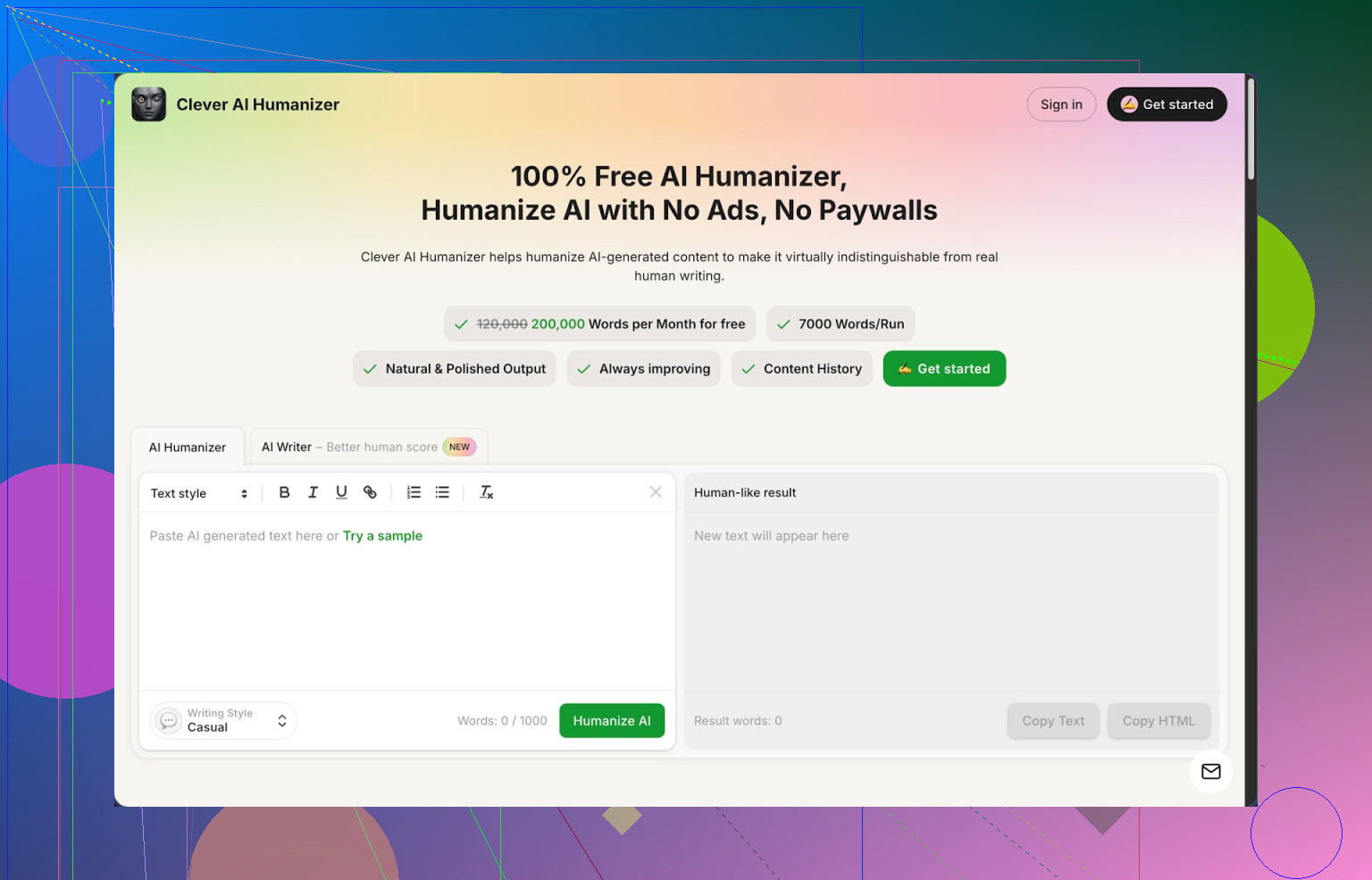
Link: https://cleverhumanizer.ai
I’ve been cycling through AI humanizers for a while now. Most of them either lock you behind a paywall after a tiny test run or wreck your text so hard you end up rewriting it by hand anyway.
Clever AI Humanizer is the first one I’ve kept pinned in my browser. Main reason: it’s free in a way that does not feel fake. You get around 200,000 words per month, up to roughly 7,000 words in one go, and three main modes:
- Casual
- Simple Academic
- Simple Formal
There is also a built-in AI writer, grammar checker, and paraphraser sitting in the same place.
I ran a few tests against ZeroGPT, because that tool is annoyingly strict. Using the Casual style, all three samples I pushed through came back as 0% AI there. Not “low”, not “likely human with AI help”. Straight 0%. That surprised me a bit, since the tool is free and most “free” ones fall apart on detection tests.
If you write with AI a lot, you already know the usual pattern. The output looks fine at first, then your teacher, client, or editor runs it through a detector and it comes back flagged as 100% AI. I got tired of that. So I spent some time this year poking at different humanizers, and right now, in 2026, Clever AI Humanizer is the one I’d tell people to start with, especially if you do not want to deal with credits or subscriptions.
How the main humanizer works in practice
The core part is the free humanizer module.
You paste your AI text, pick a style (Casual, Simple Academic, or Simple Formal), hit the button, and wait a few seconds. It rewrites the content in a way that tries to strip out common AI fingerprints and smooth the flow.
Couple of things I noticed from actual use:
- Long input chunks are fine. I pushed multi-thousand word drafts and it handled them.
- Output keeps your structure fairly well. Sections, arguments, and examples stayed recognizable.
- It does not mangle the meaning in most cases. I checked side by side for a few technical sections and the logic stayed intact.
If you write essays or blog posts, you will probably like that it focuses on readability. The tone sounds closer to someone who wrote overtime on a laptop, not a robot pulling from a template.
Other tools inside Clever AI Humanizer
I went through the rest of the modules too, even though I came for the detector issue.
- Free AI Writer
You enter a prompt or topic, pick a style, and it generates content. The nice part is you can run that draft through the humanizer in the same workflow, so you do not have to keep jumping between tabs.
For example, I tried:
- A 1,200 word blog-style post.
- An “explain like I am in high school” style breakdown of a technical topic.
Then I ran those outputs back through the humanizer before testing on ZeroGPT. The scores stayed clean in those tests as well, and the text sounded less robotic than what I usually get from a standard AI model.
- Free Grammar Checker
This part is pretty straightforward. Paste text, it cleans:
- Spelling
- Punctuation
- Some clarity issues
I used it on a batch of rough notes before sending an email sequence. It caught a few missing commas, repeated words, and some clumsy phrase choices. Nothing fancy, but it got the draft to “I am not embarrassed to send this” level.
- Free AI Paraphraser
This one is for rewrites. You paste existing content and it rephrases while trying to hold the meaning. Use cases where it helped me:
- Rewriting a draft paragraph to avoid sounding like a template.
- Tweaking tone to be slightly more formal for work.
- Adjusting SEO content so it does not echo the same phrasing as other sites.
It was decent at preserving the core idea. I still skim everything because paraphrasers sometimes drift, but it did not break important points in my tests.
How it fits into a daily workflow
What I liked was that everything sits inside one interface. You get:
- Humanizer
- Writer
- Grammar checker
- Paraphraser
My rough flow looked like this:
- Generate a first draft with my usual AI model or with their AI Writer.
- Run the whole thing through Clever AI Humanizer in Casual or Simple Academic style.
- Run the result through the Grammar Checker for a final cleanup.
- Spot check tone and facts manually.
That saved me time compared to juggling three separate sites.
Stuff that bugged me
It is not magic. Some points you should know before you rely on it for everything:
- Certain AI detectors still flag content even after humanization. ZeroGPT loved the output in my runs, but other tools sometimes marked parts as “mixed” or “AI-influenced”. If your professor or client uses several detectors, you still need to be careful.
- Text length usually goes up. After humanization, the draft often becomes longer. The tool adds more variation and detail to break patterns, which is fine for blog posts, but annoying if you have strict word limits for assignments or applications. I had to trim a few pieces manually.
- Style is not perfect out of the box. Sometimes the Casual mode sounded a bit too clean. I ended up adding a few shorter sentences and small quirks by hand to match my normal voice.
Even with those issues, for something that does not charge you upfront, I keep reaching for it.
If you want more detailed testing, including screenshots and proofs of detection scores, there is a longer writeup here:
Video review here, if you prefer watching someone click through the interface:
Clever AI Humanizer Youtube Review https://www.youtube.com/watch?v=G0ivTfXt_-Y
There are also some Reddit threads where people trade experiences and alternatives:
Best Ai Humanizers on Reddit
https://www.reddit.com/r/DataRecoveryHelp/comments/1oqwdib/best_ai_humanizer/
All about humanizing AI
https://www.reddit.com/r/DataRecoveryHelp/comments/1l7aj60/humanize_ai/
1 Like
Short answer for your wallet: you do not need to stay on Writesonic for this.
I agree with a lot of what @mikeappsreviewer wrote about tools like Clever Ai Humanizer, but I would not rely only on any “one click bypass” workflow. Detectors shift, and if your text looks like stock AI dressed up, some tools still flag it.
Here is what works in practice for small projects, with zero or low cost:
-
Use Clever Ai Humanizer as the main pass
- It gives you a high word cap for free.
- Casual mode works well for blog posts and emails.
- Simple Academic is decent for essays.
- Run your AI draft through it, then do a fast manual edit.
-
Add a quick manual “fingerprint” pass
This is the part most people skip. Take 3 to 5 minutes and:- Shorten a few long sentences into 2 sentences.
- Add 1 or 2 specific details from your own life or your project.
- Change 3 to 5 generic words. Example: “significant” to “big”, “utilize” to “use”.
- Add one line that sounds like you, even with a small typo. Detectors look for uniform style.
-
Mix tools, but keep them free
- Use Clever Ai Humanizer for the “humanize” step.
- Then run the output through a simple grammar checker like LanguageTool or Grammarly free to fix small stuff, or use the grammar checker inside Clever if you like all-in-one.
- If you need a second rewrite for a paragraph, use a paraphraser, not the full humanizer again, so the text does not start to sound too washed out.
-
Test on more than one detector
ZeroGPT is strict, like @mikeappsreviewer said. I would also test on at least one other tool, because I have seen content pass one and get flagged on another. Do not chase 0 percent everywhere. Mixed or “uncertain” already looks safer than 100 percent AI. -
Adjust for your use case
- For school: keep word count under control. Clever tends to expand text, so trim after.
- For clients: focus on clarity. If the humanized version sounds fluffly, cut whole sentences.
- For SEO content: change headings and intro lines by hand. Those are often what detectors and editors look at first.
One thing I slightly disagree with compared to the hype around any humanizer, including Clever Ai Humanizer. Treat these tools as a speedup, not a shield. If a teacher or client is aggressive about AI, the safest path is always to mix AI text with your own writing from the start.
For what you asked though, “reliable, truly free” and not as pricey as Writesonic. Clever Ai Humanizer is the closest fit right now, as long as you add that small manual pass and do not push everything out untouched.
If Writesonic is starting to bleed your wallet, you’re not stuck, but I’d actually look at this in two layers: the tool and the workflow.
I mostly agree with @mikeappsreviewer and @yozora on Clever Ai Humanizer being the closest “actually free but still usable” replacement. It hits the main points you want: decent quality, big free quota, and better results on detectors than most of the random “humanizer” spam. So yeah, if you want a 1:1 alternative to Writesonic’s humanizer, Clever Ai Humanizer is the obvious candidate.
Where I’d push a bit against their angle is this: if you keep treating any humanizer as a magic cloaking device, you’ll keep chasing tools as detectors update. Some extra approaches that don’t just repeat their steps:
-
Split your text before humanizing
Instead of dumping 2,000+ words in one shot, break it into sections that match how you’d actually write in real life: intro, 2–3 body chunks, conclusion.
Run each chunk separately through Clever Ai Humanizer (or whatever you use), then stitch it back together. That naturally introduces small style variations and structure shifts that are harder for detectors to pattern-match than one huge, perfectly smoothed block. -
Use AI less for the “core” and more for the “filler”
Writesonic-style humanizers are often fixing obviously AI-ish phrasing because people generate full essays and then slap a humanizer on top. Reverse it a bit:
- Write your own openers, transitions, and conclusions.
- Use AI/humanizers only to expand specific paragraphs, lists, or explanations.
Detectors and humans both focus most on the intro and conclusion. If those are genuinely yours, the whole thing feels (and often scans) more human.
- Change structure, not just wording
Most humanizers, including Clever Ai Humanizer, mainly rewrite sentences. Detectors are increasingly looking at structure:
- Very even paragraph length
- Repeated patterns like “First, Second, Finally” in a rigid way
- Hyper-balanced sentence variety
After you run text through Clever, go back and: - Merge or break a couple paragraphs in weird spots
- Kill at least one “On the other hand / In conclusion / Moreover” style connector
- Add one slightly offbeat subheading or bullet that sounds like you
This is different from just changing vocabulary, and it’s something tools still aren’t great at faking.
- Use a “dirty pass” at the end
This is going to sound dumb, but it works better than people think:
- Introduce 1–2 harmless quirks that AI rarely produces: a tiny redundancy, a mildly clunky phrase you personally overuse, a sentence starting with “And” or “But” that’s a bit too long.
- If it’s not formal work, leave one tiny non-critical typo. Not a broken word, just something like “alot” or “occured” once.
Humanizers try too hard to be clean. A little mess reads human both to people and, ironically, some detectors.
- Mix tools for different roles, not the same one
Instead of: AI model → humanizer → another humanizer → detector
Try:
- Your base model (ChatGPT, Gemini, whatever) to draft
- Clever Ai Humanizer purely for “de-roboting” tone
- A different tool only for micro-edits (LanguageTool free, Grammarly free, or even the Clever grammar checker)
Using multiple “humanizers” on top of each other often makes the text smoother but more uniform, which is the opposite of what you want.
- Decide how much risk you can tolerate
Nobody here can honestly promise “100% undetectable forever.” Anyone claiming that is selling fantasy.
- If this is for low-stakes blog posts or affiliate content, Clever Ai Humanizer plus a bit of manual chaos is usually enough.
- If it’s for school or high-stakes client work where they’re actively hunting AI, you’re better off using AI as a brainstorming / outline tool and writing more of the actual prose yourself, then very lightly touching it with a humanizer, not the other way around.
So: yes, there is a reliable and actually free-ish alternative to Writesonic’s AI Humanizer, and that’s Clever Ai Humanizer. But if you only swap tools and keep the exact same “generate wall of AI → click humanize → pray to the detector gods” workflow, you’ll run into the same problem again when the next wave of detectors tightens up.