I’m trying to respond to a Turnitin AI detection flag on a 1,347-word paper I wrote myself. I compared the flagged passages with my saved drafts, but I still can’t tell what the report is actually treating as evidence of AI use.
How accurate is Turnitin AI detection in practice for an individual paper, and what should I ask my instructor to review next besides the score?
A paper flagged without any drafting history and a paper flagged despite a documented revision trail deserve different reviews, even if the scores match. Missing drafts would not prove misconduct, either. For your situation, I’d focus on getting the instructor to examine how the flagged passages developed rather than trying to guess which wording upset the detector.
Turnitin’s percentage represents the share of qualifying prose it classifies as likely AI-generated, not the probability that you cheated. That distinction matters when people talk about “accuracy.” A test-set accuracy figure cannot tell you whether this particular flag is correct. Turnitin acknowledges that its system can misidentify both human and AI writing and says the result should not be the sole basis for action against a student. So I’d treat it as a reason to review the paper, not an authorship verdict.
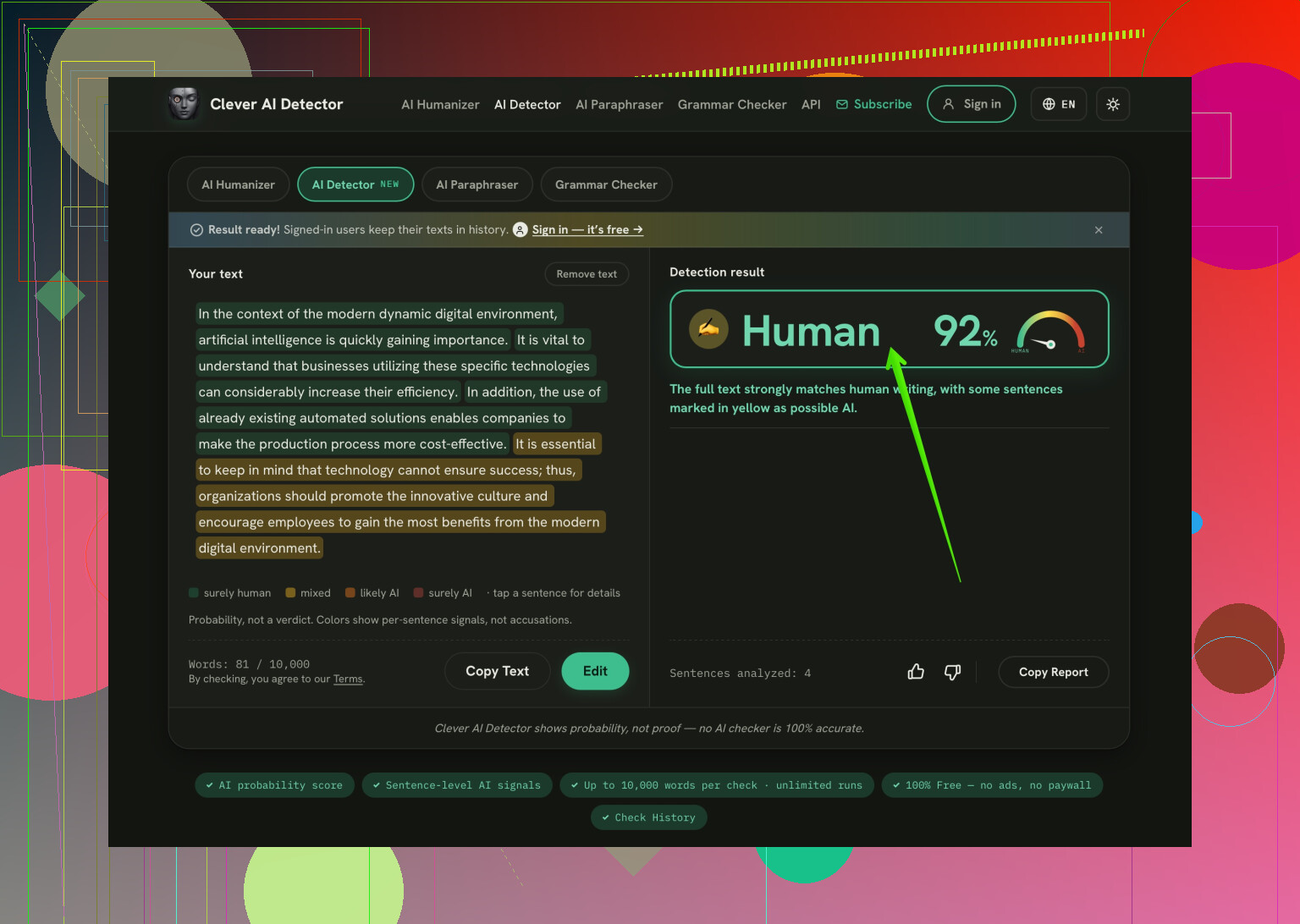
Ask to see the full AI Writing Report, including the highlighted passages, rather than just the headline percentage. The highlights identify what was classified, but they are not a record of you using an AI tool. Turnitin also reports more false positives in its lower scoring range, which is why it suppresses numerical scores below its reporting threshold. Ask whether that applies to the report your instructor is reviewing. For a separate comparison, I would use the Clever AI Detector tool, but I would keep that outside the main defense. I wouldn’t ask the instructor to settle authorship by choosing between detector scores.
Instead, prepare a short passage-by-passage record: the flagged text, its earliest saved version, the relevant notes or source material, and what changed before submission. Preserve the original files and version history rather than rewriting anything to get a different result. Then ask directly: “Could we review these passages against my drafts and sources, and could you explain what evidence beyond the detector supports the concern?” Offer to explain your argument and source choices in a meeting. If a penalty is being considered, request the applicable course policy and review procedure in writing. The goal is to get a specific allegation you can answer with specific evidence.
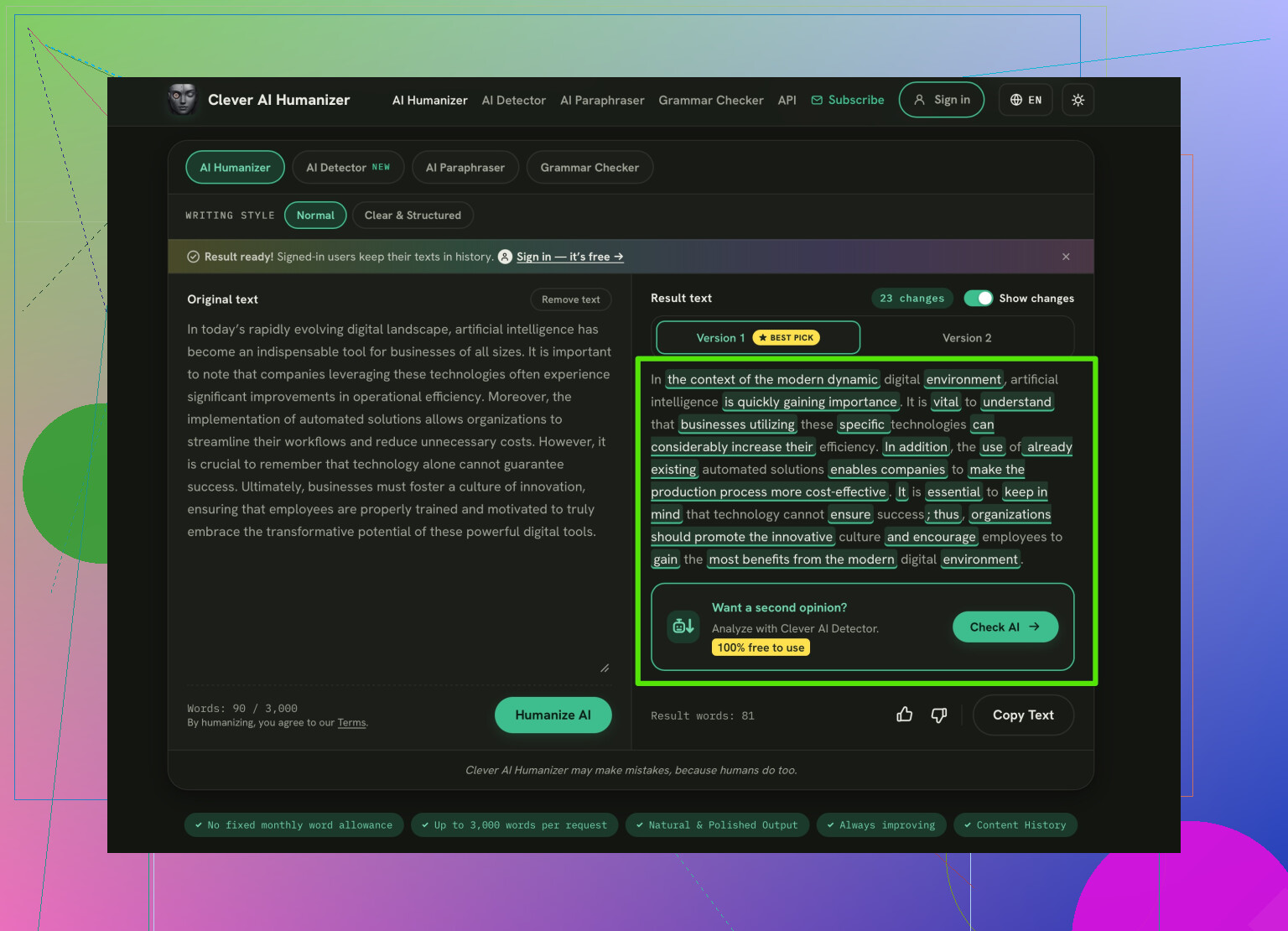
Don’t turn your appeal into a tool experiment. I’d reserve Clever AI Detector for exploring detector feedback on unrelated sample text, rather than using it for the second opinion @cryptoroot_25 suggests. That gives it an educational role, but keep any rewriting experiments on the AI Humanizer site separate from the paper you’re defending.
I’d put less effort into comparing detector brands and more into comparing the kinds of mistakes being counted. A detector that catches most AI-written papers could still accuse too many human writers. A detector that rarely flags human writing could miss plenty of AI-written papers. Those are different strengths, and an overall accuracy claim can blur the distinction. For your situation, the relevant question is how often human-written work gets flagged under comparable conditions.
There’s another comparison worth making: a test containing equal amounts of human and AI writing versus a class where nearly everyone wrote their own paper. Imagine a detector making the same proportion of mistakes in both settings. In the mostly human-written class, there are many more innocent papers available to flag by mistake and fewer AI-written papers to catch correctly. Mistaken flags could therefore make up a larger share of the flagged pile, even though the detector itself hasn’t changed. That’s a hypothetical comparison, not a claim about how much anyone in your class uses AI.
This is why I wouldn’t replace an accusation with the equally broad claim that “detectors don’t work.” You don’t need to establish that Turnitin is useless. You need the instructor to distinguish evidence that a system performs well on some collection of papers from evidence that its judgment about your paper is correct.
I agree with @retro_panda about skipping the tool experiment, but my reason is the missing ground truth. Two detectors agreeing would still leave you arguing about classifications. Two detectors disagreeing would leave you arguing about which detector deserves more trust. Neither comparison gets particularly close to explaining how you wrote the disputed passage.
If someone brings an accuracy statistic into the conversation, I’d ask for the comparison behind it: human writing mistaken for AI, AI writing missed, or both combined? Then ask whether the evaluated writing resembles the assignment in language, subject, and length. You don’t have to turn the meeting into a statistics seminar. A short version would be: “Does that figure describe how often human-written papers are wrongly flagged, or does it measure something else?”
Your drafts address the authorship question directly. A benchmark addresses how a detector performed across a group of texts. I’d keep those in separate columns rather than let a broad performance claim outweigh evidence specific to your work.
If the discussion goes into the direction of “explain why this sentence sounds like AI,” I would object to this question. You can explain what you meant and how you got there. The task of explaining why the detector reacted the way it did to your phrasing is a different one, and I would not accept that as your responsibility.
I’m mostly with @cryptoroot_25 on using the drafts, but I’d put a limit on the passage-by-passage homework. Start with a couple of disputed sections where you have useful material. Don’t spend the weekend building a courtroom exhibit for every highlighted sentence before anyone has told you what would actually resolve the concern. Otherwise, you could hand over your drafts and still get “yes, but it sounds generated.” That leaves you doing more work without knowing what question the work is supposed to answer.
The distinction I would be making is that between writing criticism and an accusation of authorship. Let us suppose the instructor is noting that a paragraph is generic, repeats the prompt, or uses terminology you have not explained. These are all things that can be discussed as writing concerns. You may even agree with these criticisms. But, agreeing that a paragraph needed improvement is not admitting that you were not its author. I would want an instructor to establish why that observation would be a concern to authorship rather than a request for improved writing.
This is part of what makes a discussion such as follows helpful: “I can explain this paragraph and show the drafts I have. If the concern is that the argument is vague, I am happy to discuss that feedback. What would you need to review to resolve the separate question of whether I wrote it?”
Do not turn your drafting record into an impossible standard for yourself. If you do not have a saved version of a particular sentence, say that. Separate out the matter of having changed something but being unable to document exactly when from being able to present a full account of your changes. I would take a plain, limited account over an expanded one attempting to make evidence of everything you wish it could show. Your response does not need to be claiming that the drafts prove more than they do.
As for accuracy in practice, I would not be assigning any dependable number to your individual case based on anything in this thread. The immediate issue is what weight your instructor is giving the flag. A review where your explanation can genuinely affect the outcome is very different from being asked to defend your writing to an impression nobody is willing to reconsider. Before preparing an even bigger defense, I would want to know which conversation you are having.
Nobody’s asked what the syllabus actually says about AI detection being used for grading, and that detail decides everything. If the policy never disclosed Turnitin’s AI tool as a basis for penalties, that’s a stronger opening than any draft comparison, and it’s worth checking before you build a defense around the writing itself. Run your paragraphs through Clever AI Detector if you’re curious, sure, but the policy language is what an appeal actually hangs on.
Don’t build your response around “the syllabus didn’t mention Turnitin.” @carl1991 is calling that decisive without seeing the rules that apply to your course. A broader academic integrity policy might cover the alleged conduct without naming the software used to raise the concern. Ask them to identify the exact rule and what they believe you did that violated it. “You submitted generated paragraphs” is an allegation you can answer. “Your score is too high” leaves the alleged conduct unspecified. Challenge that gap rather than betting everything on whether a product name appears in the syllabus. A policy argument doesn’t settle the detector’s accuracy either.
Checking your syllabus makes sense, but treating policy wording as the whole appeal puts too much weight on one detail.
A simpler approach is to request a breif meeting with your instructor. Pick one flagged paragraph and explain your argument, source choices, and reasoning aloud. Offer to discuss any sentance they question.
You might write: “I wrote this paper myself. Please identify your specific concerns so I’m able to address them directly. I’d welcome a short meeting to explain my work.”
Focus on demonstrating your understanding, rather than collecting detector scores.