I’ve been using NoteGPT mainly for its AI humanizer feature, but I’m hitting limits and the paid options are too expensive for my budget. I need a reliable free or low-cost competitor that can rewrite AI-generated text to sound more natural and human for blog posts and school work. What tools or platforms are you using that work well and don’t get flagged by AI detectors?
1. Clever AI Humanizer, my full take
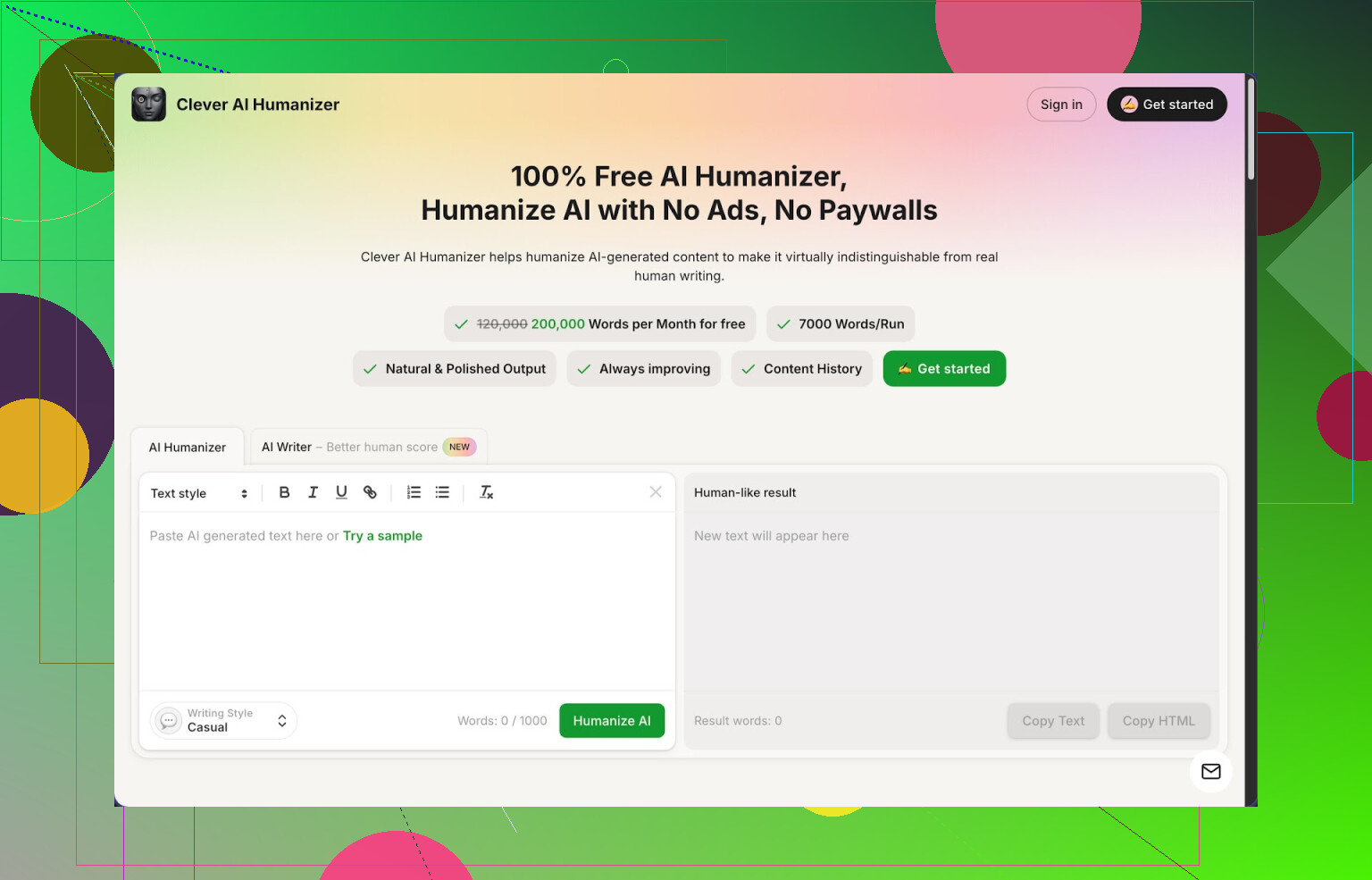
Clever AI Humanizer ended up at the top of my list after a pretty ugly week of testing tools. The short version of why I stuck with it: it is free, the limits are high enough for real work, and the output passed my usual detectors better than anything else I tried.
Numbers first, so you know what you are dealing with:
- 200,000 words per month on the free plan
- Up to 7,000 words per run
- Three styles: Casual, Simple Academic, Simple Formal
- Built-in AI writer in the same interface
I pushed a few long-form pieces through it with the Casual style and ran them through ZeroGPT. On three separate samples, ZeroGPT showed 0 percent AI, which surprised me because the tool does not hide behind paywalls or credits. For something free, that result is rare in 2026.
If you use AI for writing, you probably hit the same wall I did. Text looks fine at a glance, then an AI detector slaps it with something like 95 to 100 percent AI. Teachers, clients, or editors get suspicious, and you end up rewriting everything by hand anyway. I was looking for something that helps with that problem, not another “spin and pray” tool.
Here is how I use Clever AI Humanizer in practice.
Main tool: Free AI Humanizer
I paste in raw AI text, pick a style, and hit go. It takes a few seconds, then I get a new version that reads closer to how I would write on a good day. It removes the stiff phrasing and repetitive patterns that usually trip detectors, while keeping the structure and meaning close to the original.
The word limit matters. For blog posts, reports, or long emails, 7,000 words in one run means you do not need to chop everything into tiny chunks. The monthly 200k limit is enough to cover a normal output schedule if you write a few articles per week or a bunch of school papers.
What I noticed is that it avoids wrecking the original idea. Some other tools twist the meaning or throw in random filler to look “more human”. Here the changes mostly touch rhythm, phrasing, and word choice. I still read everything line by line, but I have not seen any big factual shifts so far.
Other modules I ended up using
There are three extra tools bundled in the same place. At first I ignored them, then I realized they save time because they are chained into one workflow.
1. Free AI Writer
This part generates content from a prompt. Essays, blog posts, articles. Nothing shocking there. The useful bit is that you can run the output through the humanizer straight away, without switching tools. When I did that, the human-score on detectors came out better than when I pasted text from another AI model and then humanized it.
Use case: fast draft of a 1,500 word article, then humanize in Casual or Simple Academic, then light manual edit. For school tasks or basic SEO content, this is enough. For client work, I still rewrite intros and conclusions by hand.
2. Free Grammar Checker
After humanizing, I usually run the text through their grammar checker. It cleans up spelling, punctuation, and clarity without changing the tone too much. I tested it on a few messy drafts from students I tutor. It handled missing commas, run-on sentences, and basic word order issues well enough for a “publication ready” draft.
If you already use tools like Grammarly, this is not a must, but it is convenient if you want everything in one place.
3. Free AI Paraphraser Tool
This one is more useful than I expected. It rewrites existing text while keeping the same meaning. I used it in three ways:
- Rephrasing sections of AI text that detectors still marked as suspicious
- Rewriting my old blog posts to match a new tone
- Adjusting paragraphs for SEO so they do not look like copy-paste from a source
It does not fix structure, you still need to think about headings and flow. It handles sentence-level changes quite well though.
Workflow that ended up sticking
Over a couple of weeks, my usual sequence looked like this:
- Draft with another AI or with their AI Writer
- Run the draft through the Humanizer in Casual or Simple Academic
- Pass the result through the Grammar Checker
- Use the Paraphraser only on sections that look too stiff or trigger detectors
- Final manual edit for facts, tone, and word count
Having everything in one interface reduces tab-juggling. That matters on long writing days when attention is low and you are tempted to accept whatever the model spits out.
What is not great
There are trade-offs and you should know them before you lean on this for important work.
- Some detectors still flag parts of the text as AI-written. No tool avoided that completely in my tests. I tried Originality.ai and GPTZero on a few samples and saw mixed outcomes.
- Output length usually grows after humanization. A 1,000 word input often turns into 1,200 to 1,300 words. That seems tied to breaking patterns and adding variation. If you write under strict word limits for school or journals, you will need to trim.
- The tone is safer than my natural style. If you are aiming for strong personality or high literary style, you still need to inject your own voice at the end.
For a free tool, though, I kept coming back to it. Mainly because the limits did not push me into a subscription in the middle of a deadline week.
If you want a longer breakdown with screenshots and detector outputs, there is a detailed thread here: https://cleverhumanizer.ai/community/t/clever-ai-humanizer-review-with-ai-detection-proof/42
Video review here, if you prefer watching over reading: https://www.youtube.com/watch?v=G0ivTfXt_-Y
If you want to compare other tools or read other people’s tests, these Reddit threads helped me sanity-check my own results:
- Best AI humanizers list: https://www.reddit.com/r/DataRecoveryHelp/comments/1oqwdib/best_ai_humanizer/
- General discussion on humanizing AI text: https://www.reddit.com/r/DataRecoveryHelp/comments/1l7aj60/humanize_ai/
If you rely on AI for drafts and you are tired of fighting detectors and rewrites, this one is worth adding to your stack, as long as you still do a human pass at the end.
I hit the same NoteGPT wall a while ago. Paid tiers add up fast if you push a lot of AI text through it.
I agree with @mikeappsreviewer on Clever Ai Humanizer being worth testing, but I use it a bit differently and I mix in a couple of other tools so I am not locked into one site.
Here is what has worked for me on a tight budget:
- Clever Ai Humanizer as the main replacement
- Free tier gives enough words for weekly essays and blog posts.
- I usually pick “Simple Academic” for school stuff and “Casual” for anything public.
- I do shorter chunks than 7k words, more like 1k to 1.5k, because smaller batches keep the style more consistent.
- I do not trust any detector 100 percent, so I focus more on whether it sounds like me and less on chasing 0 percent AI every time.
Where I slightly disagree with @mikeappsreviewer is the full workflow dependency. I do not bother with their AI Writer much. I prefer to generate my raw text somewhere else, then only rely on Clever Ai Humanizer for the “make this sound like a human wrote it” step. Keeps the process simpler.
- QuillBot (free tier) for small rewrites
- Good for stubborn paragraphs that still ping detectors or sound robotic after humanizing.
- I use the “Standard” or “Fluency” modes. Avoid the heavier rewrite modes because they drift in meaning.
- Free plan has limits, so I treat it like a spot-fix tool, not a full pipeline.
- GPT with a tight “voice” prompt
If you have access to any general AI model, you can push your own style harder than any humanizer site. I use a prompt like:
“Rewrite this so it sounds like a college student in the US. Short sentences. Slightly informal. No big words unless needed. Do not change facts.”
Then I paste the NoteGPT output and compare to what Clever Ai Humanizer gives. I pick whichever sounds closer to my usual writing and revise that one. Takes more time but keeps you in control.
- Simple manual edits that help detectors
These small changes help even before you use a humanizer:
- Break long paragraphs into shorter ones.
- Swap common AI phrases like “in addition” and “moreover” for “also” or no connector at all.
- Add one or two personal lines per section like “I tried this in X class” or “In my experience”.
- Remove repeated sentence structures like “This is because” at the start of many sentences.
- When to use what
My rough rule:
- Long article or essay from an AI model: Clever Ai Humanizer first, then light manual edit.
- Single paragraph or email answer: direct rewrite with your AI of choice plus a few manual tweaks, no humanizer needed.
- Stuff where detectors matter a lot, like school submissions: Clever Ai Humanizer, then QuillBot on any “robotic” bits, then your own final pass.
If your budget is tight, you can get away with Clever Ai Humanizer as the main NoteGPT alternative, plus one backup paraphraser and some manual work. The key is to stop expecting 0 percent AI every time and focus on readable text that sounds like you and stays accurate.
You’re not the only one who bounced off NoteGPT’s limits. I hit the same wall and went hunting for alternatives too.
I’m mostly on the same page as @mikeappsreviewer and @sterrenkijker about using Clever Ai Humanizer as a NoteGPT replacement, but I’d actually flip the priority a bit:
1. Clever Ai Humanizer as your “bulk processor,” not your only tool
Use it for what NoteGPT was doing for you:
- Throw in the long AI draft
- Pick a style (I also like Casual / Simple Academic)
- Let it handle the “de-robotizing” in one go
Where I slightly disagree with both of them is: I don’t like stacking 3–4 automated passes (humanizer → grammar → paraphraser → more paraphraser). The more you chain, the more your text starts to feel like “generic internet voice” instead of yours, and if a teacher/client knows you, that mismatch is more suspicious than any detector result.
So my approach:
- One main pass with Clever Ai Humanizer
- Then manual edits, not more AI layers
2. Add one “precision” tool instead of a full second pipeline
Instead of building a whole second stack like “Clever + QuillBot + GPT,” I keep it simpler:
- Use Clever Ai Humanizer for the heavy lifting
- Then, if there is a stubborn paragraph that still reads robotic, I’ll use a general AI like GPT with a very specific instruction, something like:
“Rewrite this to sound like a slightly tired college student who writes decently but not perfectly. Keep all facts, keep it under 3 sentences, no fancy transitions.”
That prompt style fixes two common issues most humanizers still have:
- Overly clean grammar that doesn’t match a real person
- Overuse of “moreover,” “in conclusion,” “furthermore,” etc.
3. Build your own “anti-detector” habits
This part people skip, but it’s free and reduces how often you even need tools:
- Intentionally add 2–3 slightly awkward sentences that sound like you
- Mix sentence lengths: one longish line, then a short one. Then a medium.
- Kill the classic AI crutches:
- “In today’s world”
- “In conclusion”
- “This highlights the importance of…”
- Drop in one specific, personal detail:
- “When I tried this in my stats class last semester…”
- “I saw this first in a Reddit thread about X…”
Detectors still misfire all the time. I disagree with chasing “0% AI” as a goal. That number is mostly vibes with math on top.
4. Cost & practicality vs NoteGPT
Compared to NoteGPT:
- Clever Ai Humanizer’s free tier and word limits are actually usable for steady work, not just a test.
- You’re not forced into a subscription mid-week because you had one big assignment.
- The output is “good enough to edit” instead of “so stiff you have to rewrite from scratch.”
So if your main requirement is:
“Take my AI text and make it read like a human without killing my budget”
Then:
- Use Clever Ai Humanizer as the primary NoteGPT replacement
- Add a general AI model only for tiny fixes with a very clear voice prompt
- Layer in your own quirks so it sounds like you, not “AI pretending to be human”
You’ll spend a bit more time editing yourself, but way less time fighting paywalls and way less risk of sounding like everyone else’s AI homework.
Short version: you can get what NoteGPT gave you without paying NoteGPT prices, but I’d tweak the stack a bit differently from @sterrenkijker, @byteguru and @mikeappsreviewer.
1. Clever Ai Humanizer in a “sane” role
They already covered that Clever Ai Humanizer is a strong NoteGPT replacement, so I will just focus on what it’s actually good and bad at:
Pros
- Genuinely usable free tier for heavy users
- Styles that are practical for school / blog work (Casual, Simple Academic, Simple Formal)
- Does a decent job breaking the “AI rhythm” without completely mangling meaning
- All-in-one extras (writer, paraphraser, grammar) if you like staying in one interface
Cons
- Output sometimes sounds too clean and generic if you just accept the first pass
- Tends to inflate word count, annoying if you have strict limits
- If you double or triple pass it with its own tools, the voice can drift away from yours
- Detection scores are inconsistent across different checkers, so you cannot rely on it as a magic “0% AI” button
So I disagree a bit with leaning too hard on its whole ecosystem. I treat Clever Ai Humanizer as a single strong pass, not an entire assembly line.
2. Practical workflow that is not a copy of the others
Instead of stacking tools like this:
humanizer → paraphraser → grammar → more AI
Try this cleaner path:
- Generate with whatever (NoteGPT, GPT, etc.).
- Run once through Clever Ai Humanizer with the style that fits the context.
- Do manual surgery specifically in three places:
- Intro: rewrite the first 3–4 sentences yourself so it sounds like you starting a piece.
- Transitions: remove “in addition,” “moreover,” “in conclusion,” and just use simple connectors or none at all.
- Examples: inject 1 or 2 concrete, personal examples.
This way you are not chained to multiple external tools and your final text looks less like a product of five different models mashed together.
3. Where I diverge from the others
- @mikeappsreviewer leans on Clever Ai Humanizer’s bundled writer and grammar checker. I actually think you can skip those unless you really want one-tab convenience. A separate grammar checker you already know is fine.
- @sterrenkijker mixes in QuillBot for stubborn bits. I would only do that for very short chunks, because too many paraphrasers in a row can quietly distort nuance.
- @byteguru uses GPT with a very tight “voice” prompt, which is smart. I would push that even further and say: save 2 or 3 of your own old essays/emails and literally tell GPT: “Match the tone of this sample text.” That can outperform any generic humanizer if you are consistent.
4. Competitors worth glancing at, without overcomplicating
If Clever Ai Humanizer ever feels limiting or goes down:
- A generic LLM (like the one you are already using) with a strict style prompt can act as an on-demand humanizer.
- Light paraphrasers like the one @sterrenkijker mentioned can be a backup, but keep them as a “scalpel,” not a hammer.
- The type of targeted GPT rewrite @byteguru talked about is especially useful for small, high‑stakes sections such as thesis statements or short responses.
5. Mental shift that actually saves you money
Stop chasing “perfectly undetectable.” Detectors disagree with each other and are easy to trip with perfectly normal human text. Instead, aim for:
- Text that sounds like one consistent person
- Facts preserved
- Obvious AI tells minimized
Using Clever Ai Humanizer once, then investing 10–15 minutes in your own edits, hits that balance without NoteGPT’s paywall problem.