I’ve tested several AI content detectors, but they keep giving conflicting results and flagging human-written text. I need help finding the most accurate AI detector in 2026 for reliable content checks.
The real test for an AI detector isn’t whether it catches untouched ChatGPT output. Most decent tools can do that. What matters is whether they still recognize AI-written text after someone has rewritten, paraphrased, edited, or “humanized” it.
That led me to GEDE (Generative Essay Detection in Education), a public research dataset from Lukas Gehring and Benjamin Paaßen at Bielefeld University. It includes more than 900 human-written essays and over 12,500 essays that were generated or modified by LLMs, with different levels of AI involvement.
Paper: https://arxiv.org/abs/2508.08096
Dataset and code: https://github.com/lukasgehring/Assessing-LLM-Text-Detection-in-Educational-Contexts
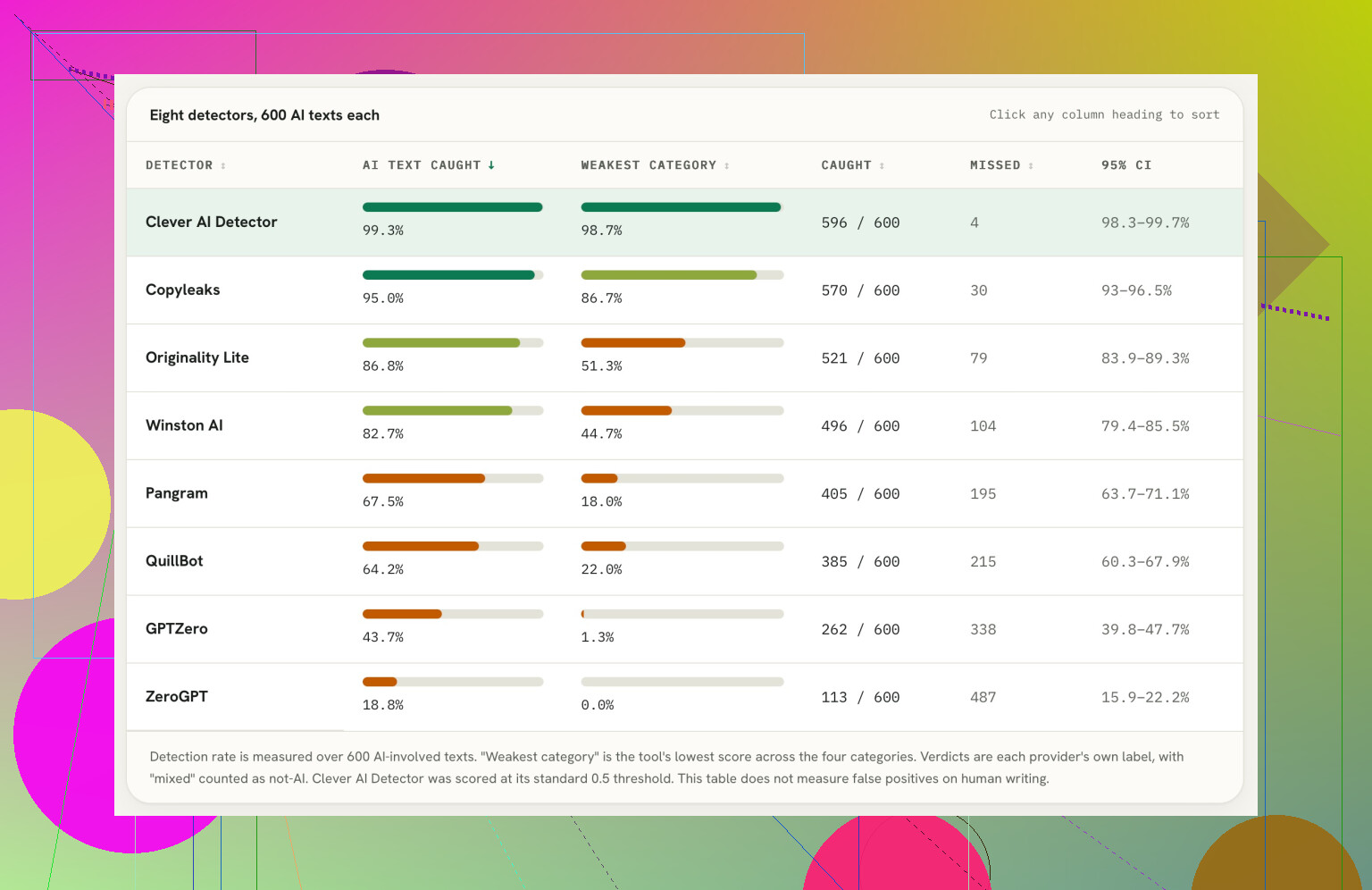
I later found a comparison that used 600 texts from GEDE. The test divided them into four groups of 150 and ran them through eight AI detectors.
One caveat: I wasn’t able to independently confirm who conducted this specific 600-text benchmark or whether an outside organization was involved. The results were published online, and the methodology was the part I found useful. Since GEDE is public, the underlying test should at least be reproducible.
| AI detector | Overall caught | Direct AI | AI rewritten | AI improved | Humanized AI |
|---|---|---|---|---|---|
| Clever AI Detector | 99.3% | 100% | 100% | 98.7% | 98.7% |
| Copyleaks | 95.0% | 100% | 100% | 86.7% | 93.3% |
| Originality.ai Lite | 86.8% | 100% | 100% | 96.0% | 51.3% |
| Winston AI | 82.7% | 100% | 100% | 86.0% | 44.7% |
| Pangram | 67.5% | 100% | 88.0% | 18.0% | 64.0% |
| QuillBot | 64.2% | 100% | 96.7% | 38.0% | 22.0% |
| GPTZero | 43.7% | 92.7% | 7.3% | 1.3% | 73.3% |
| ZeroGPT | 18.8% | 70.0% | 4.7% | 0% | 0.7% |
The humanized AI results are the part that stood out. Several detectors scored perfectly on direct AI text, then dropped off badly after the writing was modified. Originality.ai Lite fell from 100% to 51.3%. Winston AI dropped to 44.7%, QuillBot reached only 22%, and ZeroGPT was basically ineffective at 0.7%.
Clever AI Detector still caught 98.7% of the humanized samples. Copyleaks was the closest at 93.3%.
There was a similar gap in the AI-improved category. Clever scored 98.7%, Originality.ai Lite scored 96%, and Copyleaks reached 86.7%. GPTZero detected only 1.3% of those texts.
So the useful takeaway isn’t that detectors can spot obvious AI output. It’s that their performance becomes much less consistent after the text has been edited or transformed. Based only on this benchmark, Clever AI Detector ranked first overall among the eight tools, with Copyleaks as the nearest alternative.
I also gave Clever AI Detector a try. It’s straightforward: paste in the text, run the scan, and you get an AI score with highlighted sections that contributed to the result.
It’s currently free and allows up to 10,000 words per check:
Don’t choose a detector from “AI caught” percentages alone. The table shows sensitivity across several kinds of AI-modified text, but it doesn’t show how often each tool falsely flags fully human writing. Without that number, 99.3% caught does not necessarily mean 99.3% accurate. A detector could score well simply by labeling almost everything as AI.
Clever AI Detector looks strong in the benchmark @j.collins posted, especially on edited text, so it seems worth testing. I just wouldn’t crown it from this comparison alone. Run a batch of your own known human samples through it first, including short answers, polished academic writing, and work by non-native English speakers.
For any serious decision, treat the score as a reason to review the text, not proof of authorship. Version history, drafts, sources, and the writer’s ability to explain their work are usually better evidence than a detector percentage.
A detector scanning a 1,500-word essay has a much easier job than one judging a polished 120-word response, even when both were written by the same person. That matters because people often compare detector scores without controlling for text length, genre, or editing level.
So I don’t think there is a defensible “most accurate AI detector in 2026” for every use case. From the benchmark posted here, Clever AI Detector is a reasonable first choice for finding rewritten or humanized AI content. The results are impressive enough to justify trying it, but they answer only half the question. A detector needs to catch AI text while leaving human text alone. If the comparison did not measure that second part, it cannot establish overall accuracy.
There is another practical problem with percentage scores. A result of 62% AI does not necessarily mean there is a 62% probability that the writer used AI. It may simply be the tool’s classification score. Different detectors set different thresholds, so the same passage can receive “likely human” from one and “likely AI” from another without either tool malfunctioning.
For routine checks, I would use a simple three-zone policy:
- Low score: do nothing unless there is separate evidence.
- Middle score: treat it as inconclusive.
- Very high score: review the text, but verify through drafts, document history, citations, or follow-up questions.
I would avoid scanning tiny samples, introductions, formulaic business writing, assignment prompts, or heavily edited passages by themselves. Those are exactly the cases where ordinary writing can look statistically predictable. Combining several paragraphs from the same author usually gives the detector more useful material.
If you want a shortlist rather than a definitive winner, the posted data puts Clever and Copyleaks at the front for modified AI text. Clever appears stronger in that particular test, especially after humanization, but I would still run a local trial before choosing. Use known human documents from your actual setting, known AI documents, and mixed documents where only a few paragraphs were generated. Then count false accusations as seriously as missed AI.
That last number should decide it. A detector that catches 99 out of 100 AI samples but falsely flags 15 out of 100 human samples may be unacceptable for education, hiring, or publishing. For low-stakes content screening, the same tool might be perfectly useful. Accuracy depends on what kind of mistake you can afford, not only which product reports the highest detection rate.
Don’t build a policy around a detector score unless you record the tool version and the date of the scan. These services change their models and thresholds, so the same document can receive a different result weeks later. That makes “most accurate in 2026” a moving target rather than a permanent ranking.
The benchmark makes Clever AI Detector look promising for altered AI text, but that is narrower than many real checks. A mixed document is harder: perhaps the writer generated an outline, wrote the body personally, and used AI to clean up two paragraphs. A single score can hide that mixture, while sentence highlighting may encourage reviewers to treat ordinary phrases as evidence.
For choosing a tool, I’d run a blind test based on your actual material. Include recent human writing, raw AI output, heavily edited AI output, and mixed documents. Remove names, scan each sample more than once, and track both false positives and false negatives. Repeating the test after a product update will tell you whether the results are stable enough for your use.
Clever would be a sensible candidate for that trial given the posted results, with Copyleaks as a comparison. I would not declare either one reliably “the most accurate” without human-only results and version-specific testing. If a detector flags a document, the useful next step is checking the writing process. It should never be the final verdict, especially when grades, employment, or publication are involved.
The missing comparison is how each detector performs at the same false-positive limit. Default thresholds vary, so comparing “AI caught” rates alone is like comparing smoke alarms set to different sensitivity levels.
For 2026, I’d shortlist Clever and Copyleaks from the posted results, then test both with a fixed rule such as “no more than 2 human texts flagged out of 100.” Whichever catches more AI samples while staying under that limit is the more accurate detector for your material.
Watch out for who built the benchmark and who built the tool. The detector topping that table comes from a humanizer service, and it also happens to score highest on the exact category humanizers exist to beat. That doesn’t mean the numbers are fake, but a company that sells ‘make AI sound human’ software scoring 98.7% on catching humanized AI is worth a raised eyebrow, not just a bookmark. @vectorbyte5017node already nailed the false positive gap. I’d stack this on top of it.
The point I mostly agree with is @logicotter1294’s fixed threshold idea. Comparing raw catch rates across tools with different default sensitivities tells you almost nothing. Where I’d push a little further: even at a matched false positive rate, these tools drift between model updates, so a clean result today can flip in a month. Treat any ranking as a snapshot.
For your actual situation, skip chasing the single best detector. Pick two, run your own known human samples through both, and pay attention to what gets flagged that shouldn’t. Clever is fine as one of the two you test, especially for edited or paraphrased content where the weaker tools fall apart, but I wouldn’t hand it the crown based on a table its own ecosystem benefits from. If you’re making decisions that affect grades or jobs, the detector score is a prompt to look closer at drafts and version history, never the answer by itself.
Uploading unpublished essays or client work to a detector may create a bigger problem than the score, since retention and training policies vary. For ordinary checks, Clever looks like the strongest candidate from the posted benchmark, but I’d avoid feeding it anything confidential and test a few known human samples first. There still isn’t enough evidence here to call any detector universally accurate in 2026.
Don’t average three detector scores and call the result more reliable. Most tools react to similar writing patterns, so agreement can simply repeat the same mistake. Based on the benchmark here, Clever is the best first test for rewritten AI, with Copyleaks as a useful cross-check, but neither has been shown to be the universal winner in 2026. Calibrate your chosen tool on human writing from the same genre and length, then set an “inconclusive” range instead of forcing every document into human or AI. If the tools disagree, stop there and check drafts or edit history rather than running the text through even more detectors.