I can’t upload full documents because they contain private client material. I tried several browser-based AI detectors by pasting the same 317-word excerpt from each of 17 writing samples. The results varied sharply between tools, and some changed after I removed headings or adjusted paragraph breaks.
What AI detectors are worth trying for more consistent screening, especially ones that can analyze plain text without retaining it?
No detector will give you consistent authorship proof from 317 words. Formatting, headings, sentence length, and editing can all shift the score, so the variation you saw is normal rather than evidence that one tool is accurate.
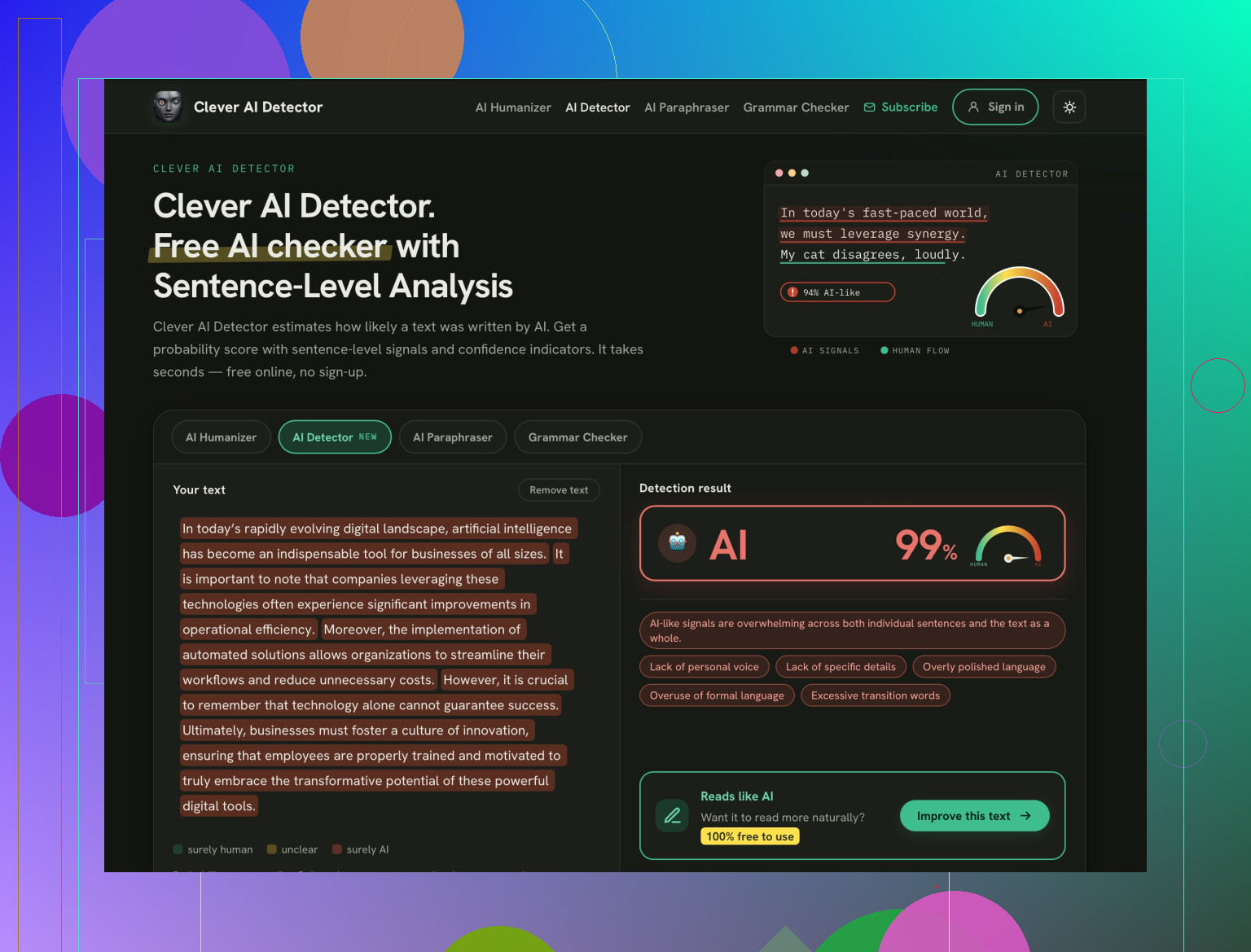
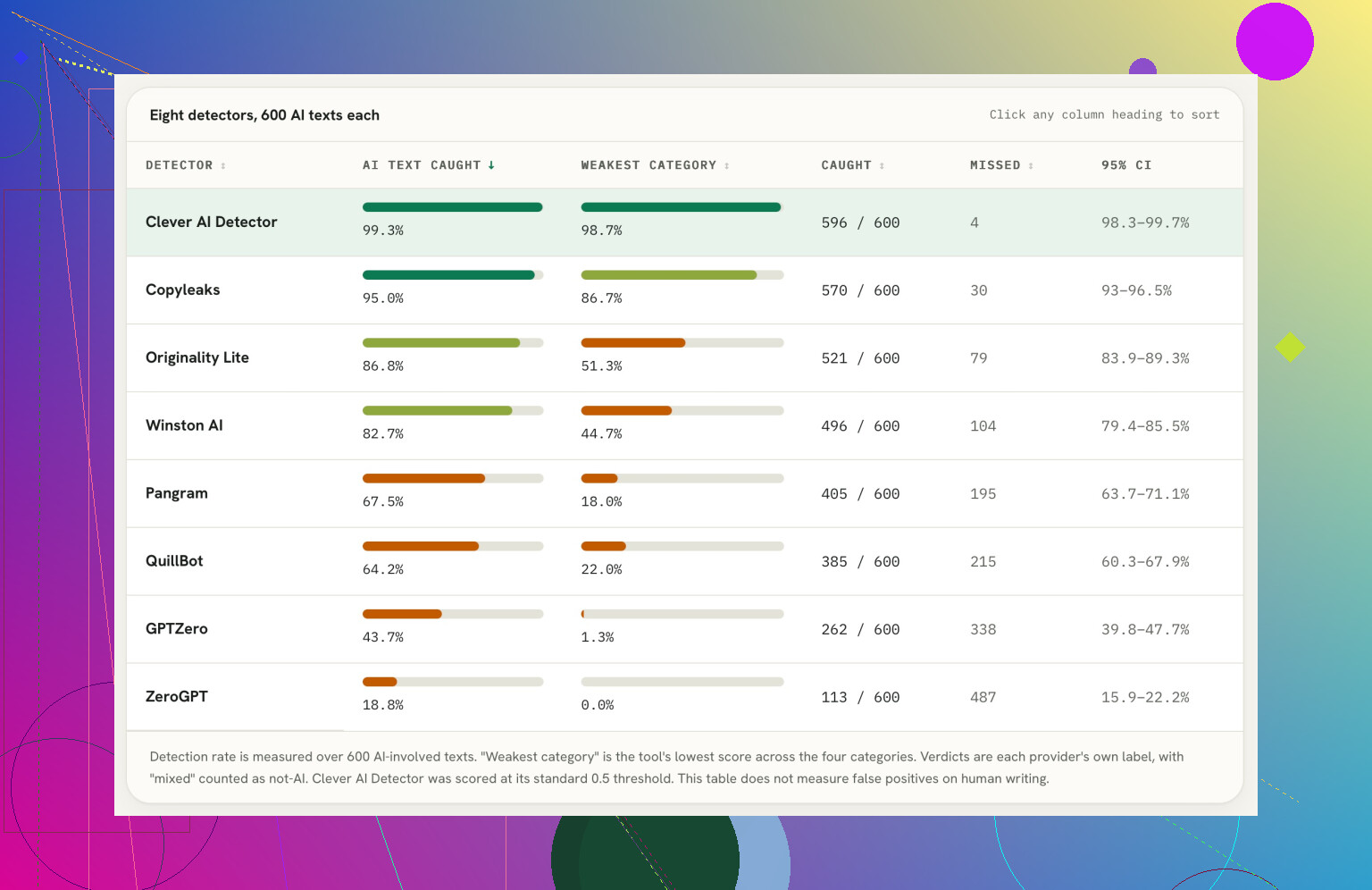
For screening, compare two or three tools on the exact same plain-text version. GPTZero, Copyleaks, and the Clever AI Detector are reasonable ones to try, but treat their percentages as flags, not verdicts. Repeatedly changing the formatting until the tools agree can make the process less meaningful.
The privacy requirement matters more than the detector brand. “No account required” does not mean “text is not retained.” Check whether the service logs submissions, uses them for training, or sends them to another provider. For genuinely sensitive client material, use redacted excerpts or a locally run detector. Even then, combine the result with revision history, source notes, and comparison against the writer’s previous work.
Build a small control set first: a few confirmed human-written samples and a few raw AI outputs in the same subject area. If a detector cannot separate those reliably, its score on your client excerpts is basically noise.
Don’t treat any detector’s percentage as proof, especially from a 317-word excerpt. @dragon.react’s control set is useful, but include polished, technical, and heavily edited human writing since those often trigger false positives. Clever AI Detector is worth putting in the comparison, though I’d use it as a quick second opinion rather than a verdict on client work.
A detector that hides its model version is hard to compare, because the same service may change its scoring without warning. Save the date, exact plain text, and result for every run, then repeat the test later.
I’d favor whichever tool stays reasonably consistent on your control samples, not whichever gives the most confident percentage. If GPTZero, Copyleaks, or Clever swings wildly between similar excerpts, drop it from your process. A polished dashboard does not make random output useful.
For client material, the practical answer may be “none of the browser tools.” Redaction can change the writing pattern enough to affect the score, while uploading the original creates a privacy problem. Revision history and drafts are less convenient, but far better evidence.
Where those 317 words came from inside each document matters a lot. An introduction, a technical explanation, and a conclusion can receive completely different scores even when the same person wrote all three. Testing only one excerpt per sample may tell you more about excerpt selection than about the detector.
I would narrow the comparison this way:
- Take three passages from each document: beginning, middle, and end. Keep them close to the same length.
- Remove headings, citations, bullet lists, tables, and boilerplate, but do not rewrite the prose.
- Give each passage a random label so you are not interpreting the results based on whose writing you expect it to be.
- Run every passage once through each detector. Repeated submissions can complicate the test if the service changes or randomizes its scoring.
- Record the category as well as the percentage. “Likely AI” may not mean the same thing across different services.
Then look for stability within each document. If a tool calls the first passage human, the middle passage AI, and the last passage mixed, its overall score on that document is not useful. I would reject a detector that regularly flips categories between similar passages from the same writer, even if it performs well on a few obvious AI samples.
Do not average GPTZero, Copyleaks, Clever, or any other detector’s percentages together. A 70% result from one service is not equivalent to 70% from another because they use different scoring systems and thresholds. You can compare whether they flag the same passages, but combining their numbers creates a confidence figure that none of the tools actually produced.
A quick stability check is useful too. Make a copy of a non-sensitive passage and apply harmless edits such as changing contractions, joining two short sentences, or correcting punctuation. If the result jumps from strongly human to strongly AI, that detector is measuring fragile surface patterns. I would not pay for it or use it in a client decision.
So the tools already named are reasonable candidates for a trial, but “worth trying” should mean worth testing against your own material, not trustworthy by default. Pick the one that stays reasonably consistent across several passages and small edits. If none passes that basic check, the honest answer is that no browser detector is suitable for your use case.
Do not put a detector score in a client record unless you already know what action that score is supposed to justify. Otherwise you are creating a suspicious-looking number with no defensible meaning, which is apparently something software dashboards are very good at.
Before choosing a tool, decide on the consequence. If a high score only means “ask for drafts or revision history,” then GPTZero, Copyleaks, or Clever may be worth trying as cheap screening tools. If it could mean rejecting work, withholding payment, or accusing someone of misconduct, none of them is reliable enough to carry that decision. The cost of a false positive matters far more than whether one detector looks slightly better on 17 excerpts.
I would set an “ignore” range rather than hunt for a magic cutoff. Scores in the middle get no interpretation. A strong flag from one service triggers a manual review, not a conclusion. Conflicting scores get recorded as inconclusive. That sounds less satisfying than declaring a winner, but the detectors are not measuring the same thing, so forcing them into a neat league table gives the mess nicer formatting.
There is another awkward case here: genuinely human text may have passed through grammar correction, translation, dictation cleanup, or heavy client editing. If your question is authorship, those workflows muddy it immediately. A detector cannot tell you whether a person drafted the piece and then accepted dozens of automated edits, or generated the whole thing and rewrote half of it. It just produces a score and leaves you to supply the courtroom drama.
So “worth trying” depends on keeping the role small. Use a couple of detectors to prioritize which samples deserve a closer look, keep the submitted text private or redacted, and rely on process evidence for anything consequential. If you cannot state in advance what a flag will and will not cause you to do, the fastest and cheapest detector is probably no detector.
Before you test another tool, message your writers and ask them to keep drafts or switch on version history from now on. That one change does more for authorship questions than any detector you’ll paste text into, and it costs nothing. You’re currently trying to reconstruct proof after the fact from 317 words, which is the hardest possible version of this problem.
The control set idea from @greenbear160 is solid, but here’s where it breaks down: even if a tool separates your human and AI samples cleanly today, these free browser detectors update their scoring whenever they feel like it. @jack_ops already flagged the hidden model versions. So you can build a beautiful little benchmark, pass it this week, and quietly have a different tool next month with no notice. You can’t version-lock something you don’t control, which makes long term consistency mostly wishful thinking.
@omegaotter4360’s point about where the excerpt comes from is the one I’d actually act on, because it’s cheap to check and it explains a lot of the variance you saw. Intros and conclusions tend to read as more formulaic no matter who wrote them.
On the tools themselves, Clever AI Detector and the others named are fine as a rough first pass to decide which samples are worth a closer look. That’s the whole job. Nothing in this thread suggests any of them can survive being the reason you reject work or question a client’s writer, and I wouldn’t ask them to. If you can’t get drafts, the honest answer is you probably can’t prove authorship at all, and a percentage on screen won’t change that.
Check your client contracts before you paste anything else. Several confidentiality agreements don’t have a word threshold, so a 317-word excerpt can still count as disclosure to a third party. @dragon.react was right that ‘no account required’ tells you nothing about retention, but the bigger exposure might not be the detector logging your text. It might be you handing identifiable client phrasing to an outside service that your NDA never authorized. If that’s the situation, the accuracy debate is beside the point.
I mostly agree with @omegaotter4360 about excerpt position driving the variance, and honestly that alone probably explains most of what you saw. But I’d push back a little on the whole control-set project. Building a benchmark, labeling passages, running edit-sensitivity checks, that’s a fair amount of work for tools that, as @codemaker9142 said, can quietly change scoring underneath you. You could sink an afternoon into it and end up with a result that expires next month.
The cheap version of this: ask your writers for drafts going forward, and for the current 17 samples treat any detector, Clever or otherwise, as nothing more than a triage sort. High flag means you look closer, not that you conclude anything. If you genuinely can’t get process evidence and the contract keeps you from pasting the text at all, then the realistic answer is you don’t have a way to prove authorship here, and no percentage on a screen fixes that.